Omega nebula and Eagle nebula
The Omega nebula, also known as the Swan nebula or M17, is just barely visible to the unaided eye on a dark, moonless night. So, to get a good look, it’s best to use binoculars or a telescope with low-power magnification. Also, the Omega nebula is very near another prominent nebula, known as M16 or the Eagle nebula. Plus, M16 is the home of the famous Pillars of Creation. In the sky, M16 and M17 appear as two closely-knit patches of haze. Indeed, they fit readily within the same binocular field of view.
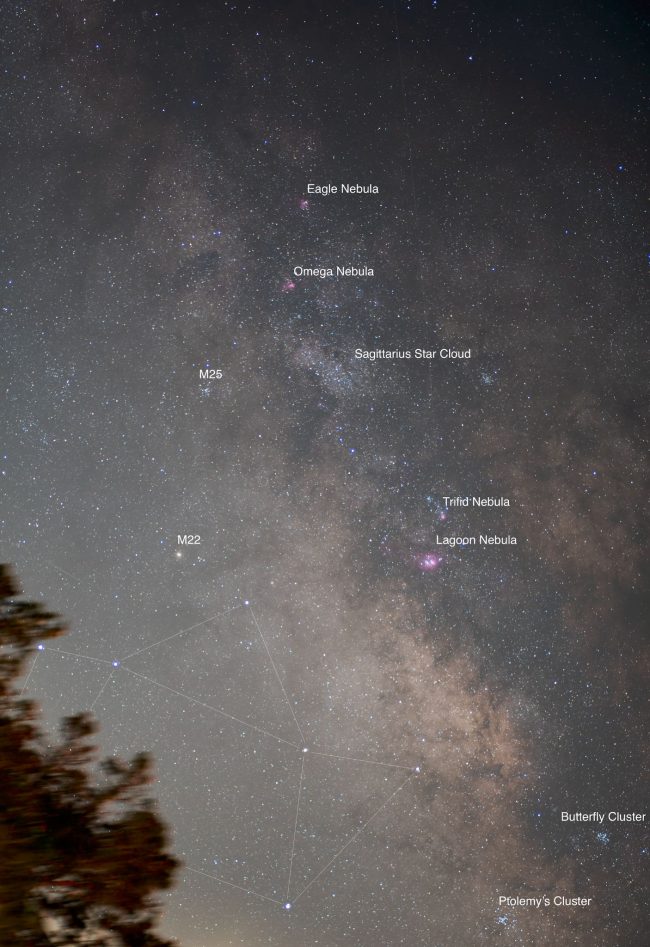
You can find them within the hazy band of our Milky Way galaxy that crosses the sky on a northern summer evening. This region of the sky is crowded with deep-sky objects, and to be sure, these two nebulae are among the best of the bunch!

How to see the Omega nebula
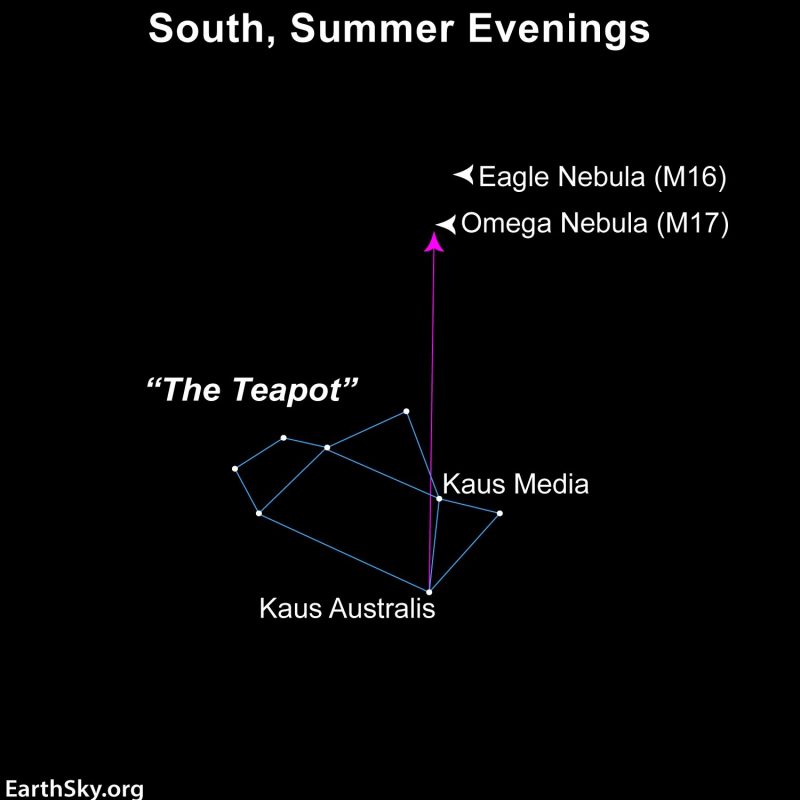
If you want to see M17 and many other deep-sky objects, learn to recognize the constellation Sagittarius the Archer, with its famous Teapot asterism. The Teapot is located in the direction of the star-rich center of our Milky Way galaxy. So there are many beautiful star clusters and nebulae in this part of the sky. And, it’s an easy star-hop from the Teapot to M17 and its nearby companion on the sky’s dome, M16.
As an illustration, draw an imaginary line from the star Kaus Australis (also known as Epsilon Sagittarii) in the Teapot and pass to the left of the star Kaus Media (or Delta Sagittarii) to locate M16 and M17. These two nebulae are close together and located about one fist-width above the Teapot.
As seen from the Northern Hemisphere, M16 and M17 are summertime objects. They’re highest up when they’re due south on late August evenings. And in addition, they’re wintertime objects in the Southern Hemisphere, where they’re closer to being overhead.
The nebula of many names
Objects in astronomy often have more than one name. That’s because they get their names from being observed and studied by various astronomers over the years. Amateur astronomers tend to call deep-sky objects by their “M” names, or Messier names. But all of these objects have proper names as well. M17, in particular, has at least five proper names: the Omega nebula, Horseshoe nebula, Checkmark nebula, Swan nebula and Lobster nebula. Learn where these names came from here.
The science of M17
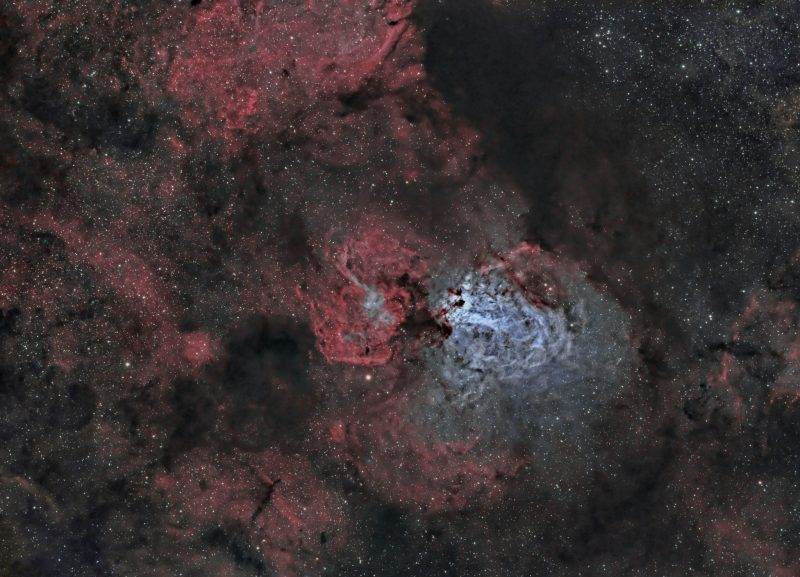
The Omega nebula is a vast interstellar cloud of dust and gas giving birth to young, hot stars. In fact, it spans some 15 light-years in diameter, with a mass of around 800 solar masses. And it’s part of a larger cloud, roughly 40 light-years in diameter with a mass of 30,000 solar masses.
Astronomers don’t know the distance to M17 with precision. But they estimate that it’s around 5,500 light-years away. For comparison, the more brilliant Orion nebula is some 1,300 light-years distant. While the Orion nebula resides within the Milky Way’s Orion spiral arm (just like our solar system), when you look at M17 or M16 you’re seeing wonders from our galaxy’s next arm inward: the Sagittarius arm.
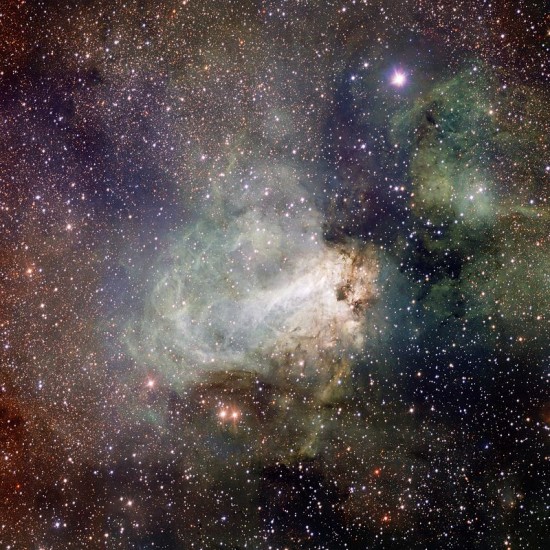
Competing nebulae
There are many glorious deep-sky objects in this part of the night sky. Two of the most famous patches of nebulosity – M8 and M20 – also vie for your attention from the Sagittarius arm. And like M16 and M17, they couple up within the same binocular field. Judge for yourself which pair of stellar nurseries is most impressive!
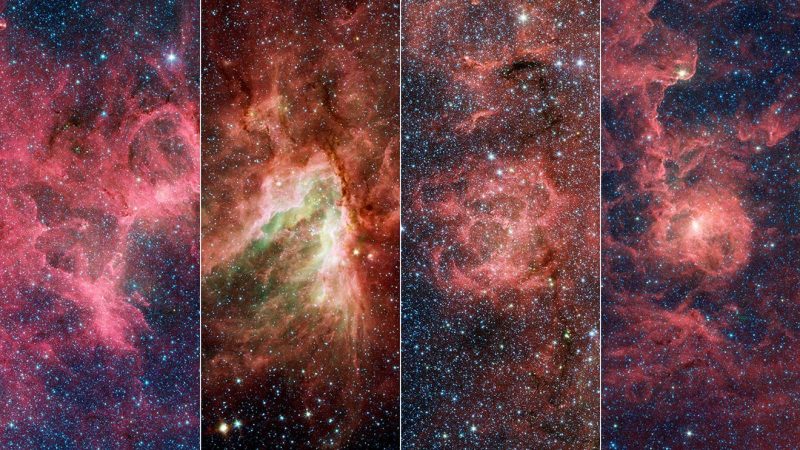
Bottom line: Barely visible to the unaided eye on a dark night, the star-forming region known as the Omega nebula or M17 is best seen through binoculars, or low power in a telescope.
Like what you read?
Subscribe and receive daily news delivered to your inbox.
More from
Bruce McClure


Can a single season have only 2 full moons?

Virgo the Maiden represents a harvest goddess