



Double Cluster in Perseus
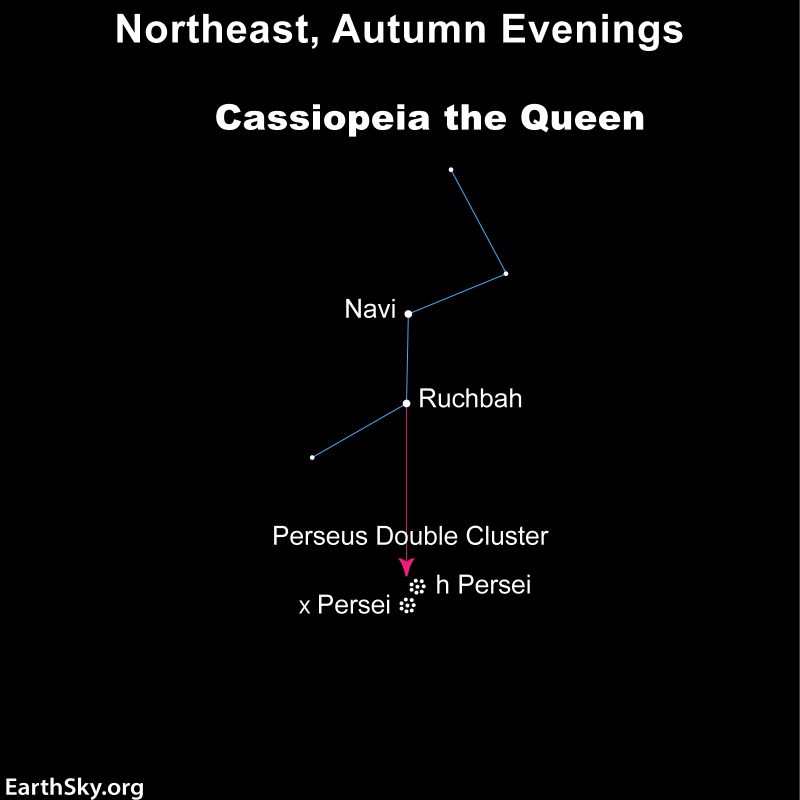
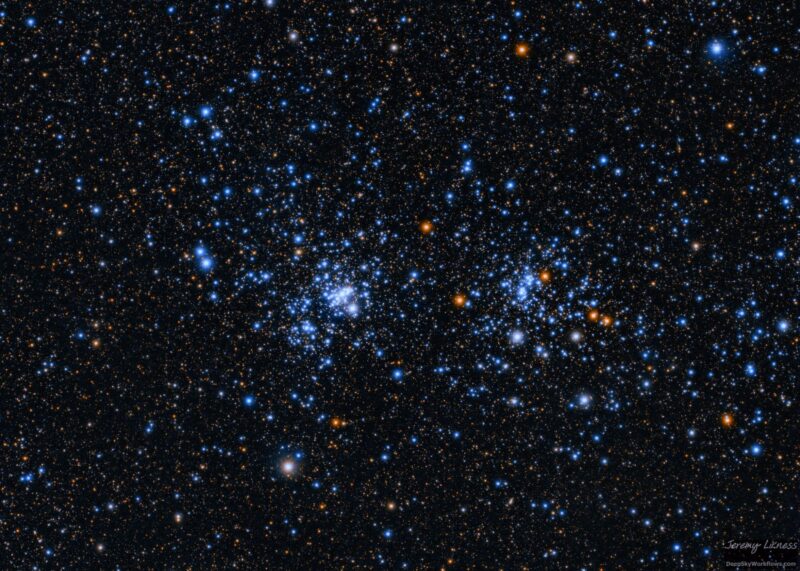
The Double Cluster in Perseus consists of two open star clusters near each other on the sky’s dome. Amateur astronomers know them as h Persei and chi Persei. The two clusters reside in the northern part of the constellation Perseus, quite close to the constellation Cassiopeia the Queen. If you have a dark sky and find Cassiopeia – which is easy, because the constellation has a distinctive M or W shape – be sure to look for Perseus, too. Then just scan between the two constellations with your binoculars for two glittering groups of stars. The Double Cluster – a breathtaking pair of open clusters, each containing supergiant suns – will be there.
These two star clusters are located about 7,500 light-years away. It’s amazing that we can see these stars at all across this great span of space. Plus, we know they must be intrinsically bright stars, or we wouldn’t be able to see them. Each cluster contains a few hundred stars, and, indeed, these stars are young, hot supergiant suns. They are many thousands of times more luminous than our sun.
Astronomers tell us that the Double Cluster lies within the Perseus arm of the Milky Way galaxy. However, our solar system resides in the inner part of the Orion arm. Therefore, looking at the Double Cluster, we are looking through our local spiral arm and all the way to the next spiral arm outward from the galactic center.
How to find the Double Cluster in Perseus
To locate the Double Cluster, find the W- or M-shaped constellation Cassiopeia the Queen. If your sky is dark enough, you will be able to see the graceful pattern of Perseus the Hero nearby. Then scan between them with binoculars to find the Double Cluster.
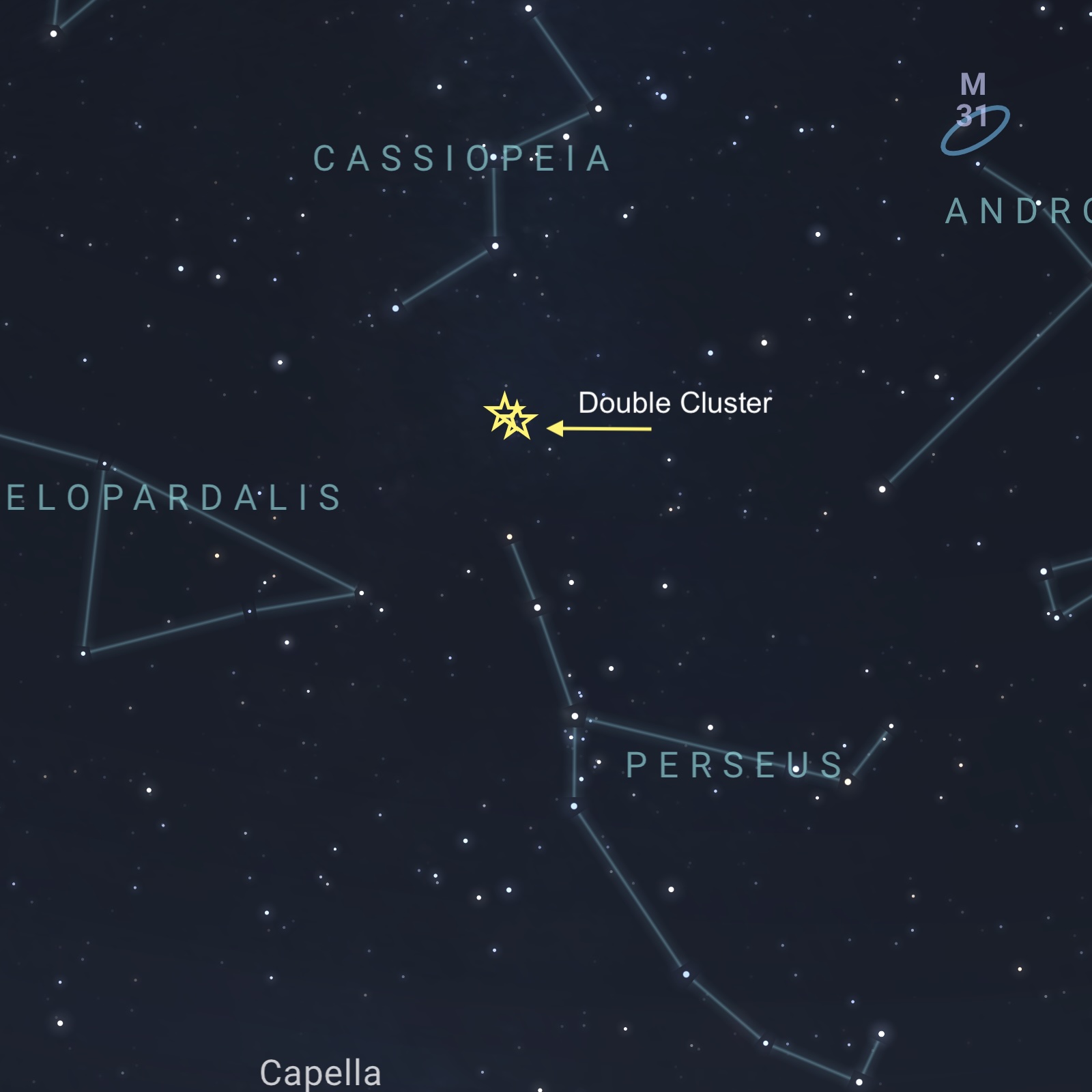
Starting at mid-northern latitudes, the Double Cluster is circumpolar, so it’s above the horizon every night of the year at any hour of the night. If you are farther south (but still in the Northern Hemisphere), try looking for the Double Cluster on any clear autumn or winter night.
But remember, the Double Cluster is harder to see when it’s close to the horizon. If you can’t spot it between Cassiopeia and Perseus, wait until later at night. Or look later in the year, when it’s higher in the sky.
For general reference, the Double Cluster is high in the sky when the Big Dipper is low, and vice versa. Because the Big Dipper is lowest in the northern sky on late autumn and early winter evenings, the Double Cluster is highest in the northern sky at these times. As a matter of fact, the Double Cluster is pretty much always visible in the evening except in late spring and summer.
The Double Cluster in Perseus is visible to the unaided eye
The Double Cluster rates among the most magnificent deep-sky objects not to be included in the famous Messier catalog. Of course, Charles Messier (1730-1817) was looking for deep-sky objects that could be mistaken for comets. Maybe he thought nobody would see this pair of glittery clusters as a comet in the sky.
Although considered a deep-sky jewel, the Double Cluster is visible to the unaided eye in a dark country sky.
If you zoom in on them with binoculars or a wide view telescope, you’ll see them as two glorious star clusters. Also they’re an easy target through a telescope and will wow your friends!
The position of h Persei is Right Ascension: 2h 19m; Declination: 57o 9′ north
The position of chi Persei is Right Ascension: 2h 22.4m; Declination: 57o 7′ north
The Double Cluster from our EarthSky Community

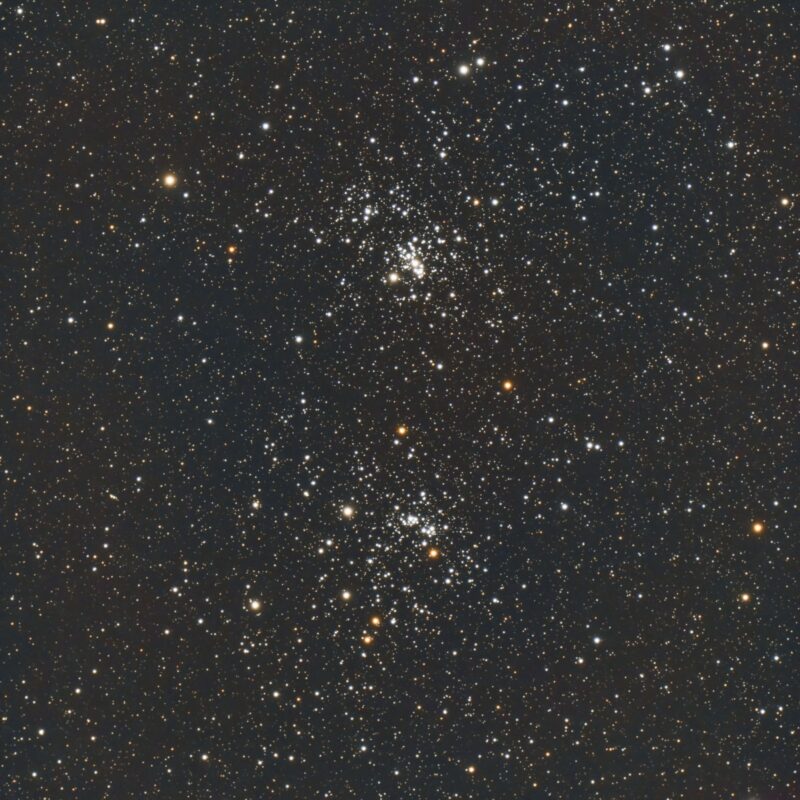
Bottom line: On any autumn or winter evening, scan between Cassiopeia and Perseus for the magnificent Double Cluster in Perseus. The stars in these two clusters are young, hot supergiant suns that are many thousands of times more luminous than our sun.
Like what you read?
Subscribe and receive daily news delivered to your inbox.
More from
Bruce McClure


Can a single season have only 2 full moons?

Virgo the Maiden represents a harvest goddess


