Its name rhymes with Obi-wan Kenobi
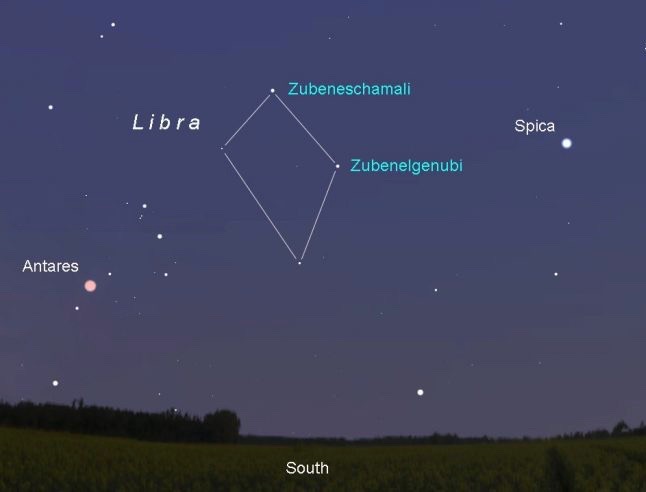
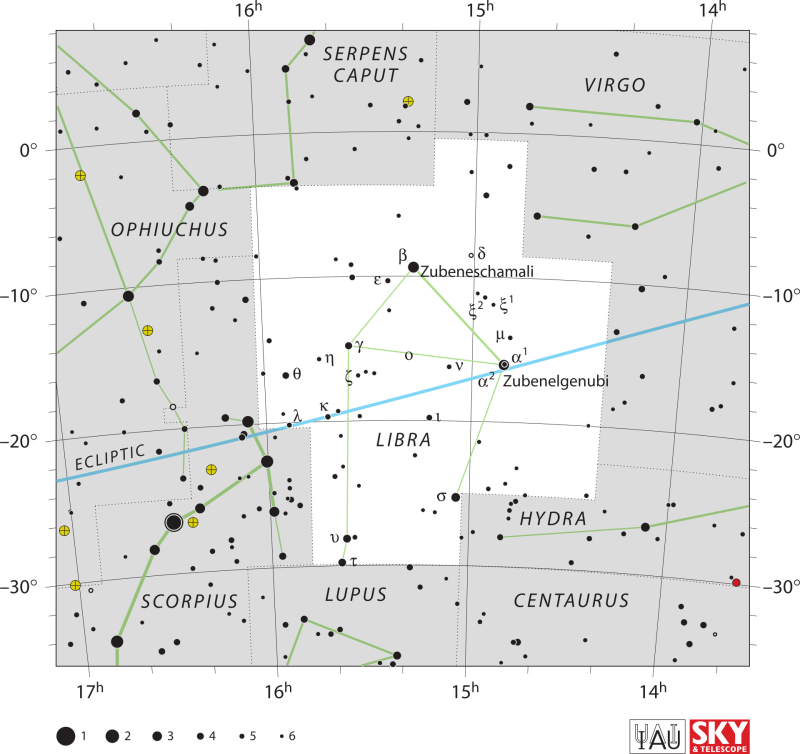
Despite its “alpha” designation, Zubenelgenubi is the second-brightest star in the constellation Libra the Scales. In short, it’s a touch fainter than Zubeneschamali, Libra’s brightest star. These two stars are most easily found in relationship to each other. Zubenelgenubi likely enjoys the alpha designation in Libra because it lies near the ecliptic – or path of the sun, moon and planets – in our sky.
The ecliptic is the path of the sun, moon and planets in our sky. All of these objects travel on or near this celestial pathway. Sometimes they stray off the ecliptic and pass between these two stars in Libra. Thus Zubenelgenubi and Zubeneschamali are considered a “gateway” in the sky.
Libra’s name originates from the word “scales” in Latin. Zubenelgenubi and Zubeneschamali symbolize divine justice. More about that below.
Learn to pronounce Zubeneschamali, and learn to pronounce Zubenelgenubi.
Read more about Zubeneschamali here
How to see Zubenelgenubi
Zubenelgenubi sits midway between two brilliant stars in other constellations. It’s between Antares in the constellation Scorpius and Spica of the constellation Virgo.
Zubenelgenubi shines to the west (right) of ruddy Antares, and to the east (left) of blue-white Spica.
The best time to see Zubenelgenubi each year begins in early May. That’s when this star is opposite the sun in Earth’s sky. Shortly after May Day, Zubenelgenubi rises around sunset, stays up all night, then sets around sunrise. In early May, this star transits – reaches its highest spot in the southern sky – around midnight local time for all observers around the globe (1 a.m. local daylight saving time). Because this star (and all stars) returns to the same spot in the sky four minutes earlier each day (or two hours earlier monthly), Zubenelgenubi transits due south around 10 p.m. (11 p.m. local daylight saving time) in early June, and earlier still in July and August.
That’s why Northern Hemisphere summer (or Southern Hemisphere winter) evenings present a good time for viewing this star. During these months, it’s high up at a convenient time of night. Zubenelgenubi isn’t as bright as some other stars, but is easily visible in a dark country sky. It is fairly easy to locate near its fellow star in Libra, Zubeneschamali.
Half a year later, after Halloween each year, Zubenelgenubi rises and sets with the sun, and isn’t visible at all. Annually, the sun and Zubenelgenubi are in conjunction on or near November 7.
Zubenelgenubi science
Zubenelgenubi resides some 75 light-years away. And it shines at around magnitude 3. Use binoculars to peer at it, and you’ll see it looks like two stars. Spectroscopy reveals each of the two stars in Zubenelgenubi are also double stars. Plus there may be a fifth star in the system.
All of these stars share a common proper motion through space – a sideways motion in our sky – suggesting they’re all gravitationally bound. Astronomers studying the motions of Zubenelgenubi’s two primary stars think the two stars orbit a common center of mass.
However, the two stars in Zubenelgenubi are widely separated by around 5,400 astronomical units (AU). That’s 5,400 times the Earth-sun distance. At our distance from the sun, we complete an orbit in a year. But such a distant separation means a long orbital period of around 200,000 years.
So their large separation suggests these two stars might not be bound by gravity, after all.
History and mythology of Zubenelgenubi
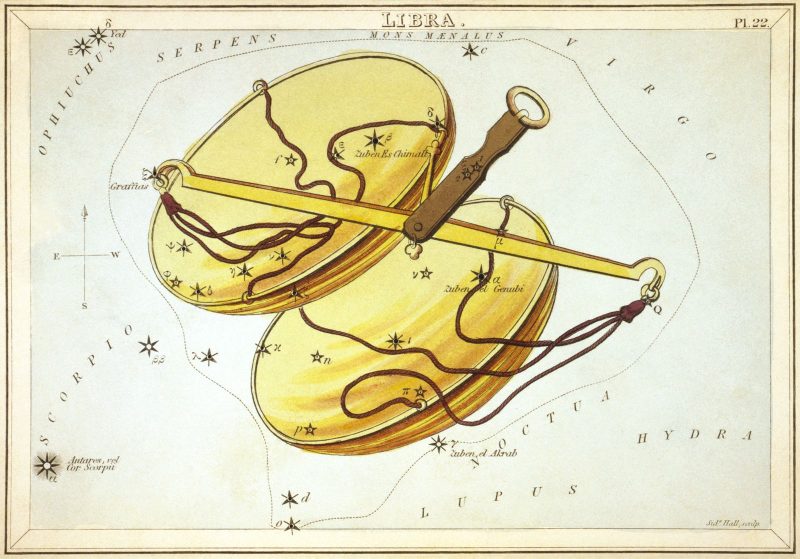
The names of Libra’s two brightest stars come from Arabic. Zubenelgenubi means “the Southern Claw (of the Scorpion)” and Zubeneschamali means the “the Northern Claw.” These names hark back to the time of the ancient Babylonians, who saw these Libra stars as part of the constellation Scorpius the Scorpion.
Apparently, the Greeks and Romans separated this part of Scorpius into the constellation Libra the Scales because the sun shone in front of this constellation on the autumn equinox. Therefore, the balance symbolizes the equal lengths of the day and night that come with the equinox. Libra marked the position of the autumn equinox well over 2,000 years ago. At present, the sun shines in front of the constellation Virgo on the autumn equinox.
According to Greek mythology, Virgo represents Astrea, the goddess of justice, holding Libra the Scales. Richard Hinckley Allen, in his classic work Star Names: Their Lore and Meaning, says Libra in Roman eyes may have been the deification of Augustus as the arbiter of justice.
Zubenelgenubi’s position is at RA: 14h 51.4m, dec: -16° 5′
An overexposed Jupiter, its moon Callisto, and the "double" star system Zubenelgenubi last night (both bright components themselves have faint, close companions, and there's probably at least a fifth star in the mix). Quick + dirty 9x30s lights pic.twitter.com/WGgLnmP87J
— julian (@juliancd38) June 12, 2018
Bottom line: Learn to recognize Zubenelgenubi, or Alpha Librae, in the the constellation Libra.
Like what you read?
Subscribe and receive daily news delivered to your inbox.
More from
Bruce McClure


Can a single season have only 2 full moons?

Virgo the Maiden represents a harvest goddess