



Castor, the less-bright Twin
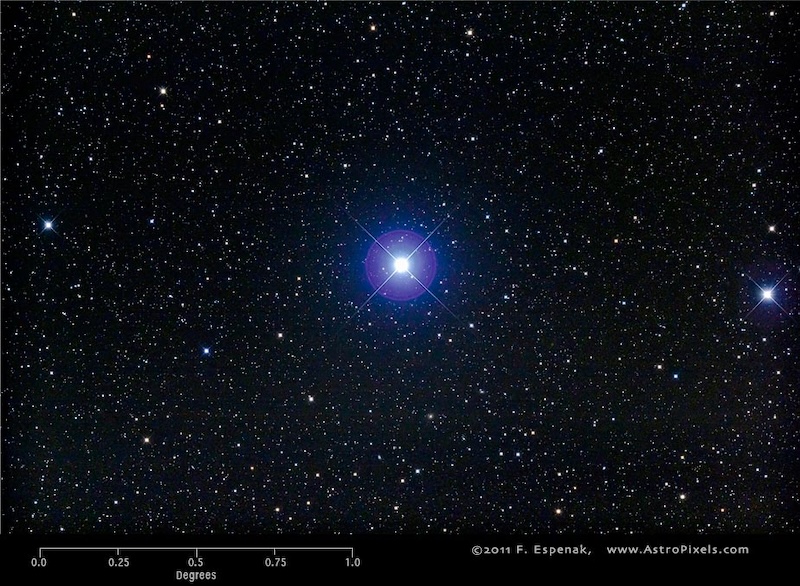
Castor, in the constellation Gemini the Twins, shines with a bright white light. That’s in contrast to the golden glow of its brother star in Gemini, Pollux. Despite being labeled as twins, Castor and Pollux are not gravitationally bound. Yet Castor is gravitationally bound into a multiple system of its own. In fact, it’s six stars in one!
Castor’s other designation is Alpha Geminorum. And usually an alpha star is the brightest in its constellation. But Castor is 2nd-brightest in Gemini, however, after Pollux (or Beta Geminorum).
Castor is about 51 light-years away. Meanwhile, Pollux is only 34 light-years away. So Pollux is closer to us. And their distances also show Pollux and Castor aren’t gravitationally bound, but only near each other along our line of sight.
And in 2026 Jupiter is nearby

Castor is a complex star system
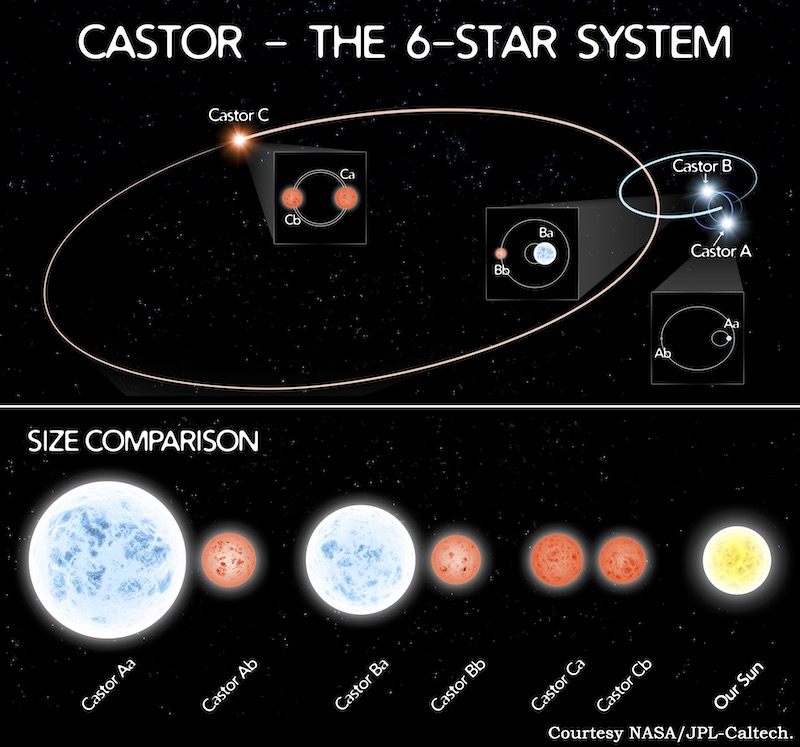
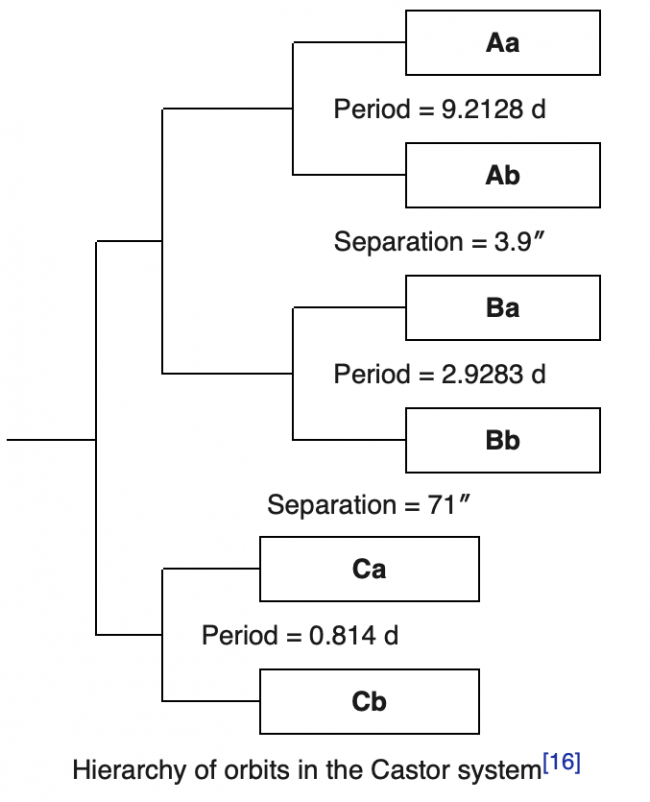
Castor is three pairs of binary stars – six stars in all – in a complex dance around a common center of mass.
Even a fairly small telescope will show Castor as two stars. In addition, you might glimpse a much-fainter star nearby, too; it’s also part of the Castor system. Each of these three stars – called Castor A, B and C – is also double. Telescopes don’t show them as double directly. But a spectroscope – which splits starlight into its component colors – reveals each of the three stars as double.
The two larger visible components in the Castor system are hot A-type stars. On the other hand, the smaller components are cool, M-type red dwarf stars.
Altogether, the mass of all six stars is, very roughly, about six times that of our sun.
Visualizing the separation of the stars
Another way to find the Twins
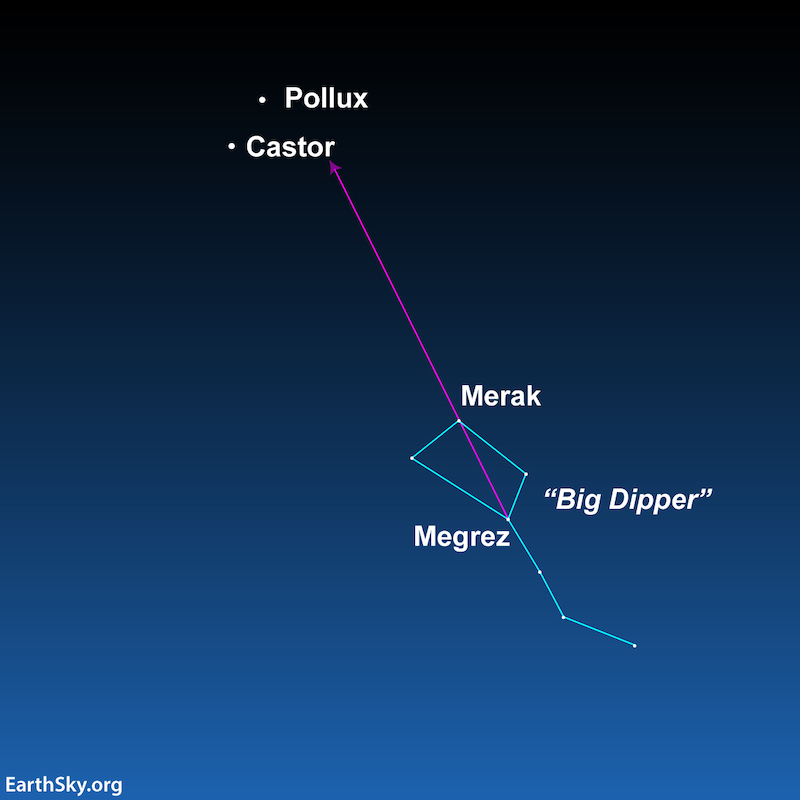
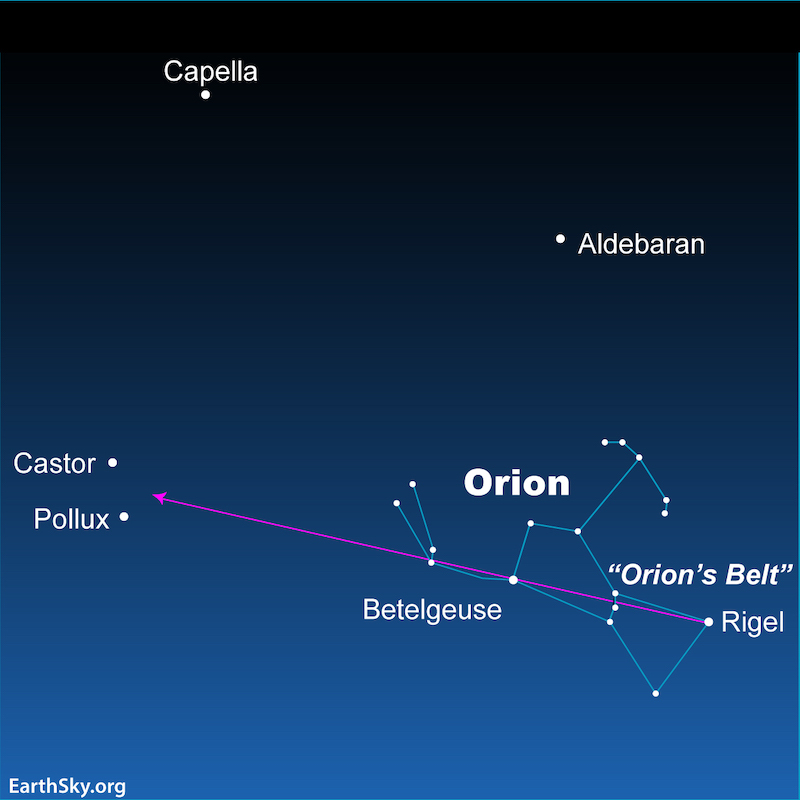
Northern Hemisphere skywatchers can find Castor and Pollux using the Big Dipper as a guide, as shown on the chart at the top of this post. And, from anywhere on the globe, you can use the constellation Orion the Hunter (see chart below) to find the the twins.
Star-hop from Orion to the “twin” stars Castor and Pollux by drawing an imaginary line from Orion’s bright star Rigel through its bright star Betelgeuse. Then, extend this line about three times the distance between these two stars.
This line will point to Castor and Pollux.
Want the view from your specific location at a specific time of year? Try Stellarium.
Greek mythology of Castor and Pollux
The reason for the name Castor is unclear. There appears to be no specific connection with a beaver, which is what the word means in Latin.
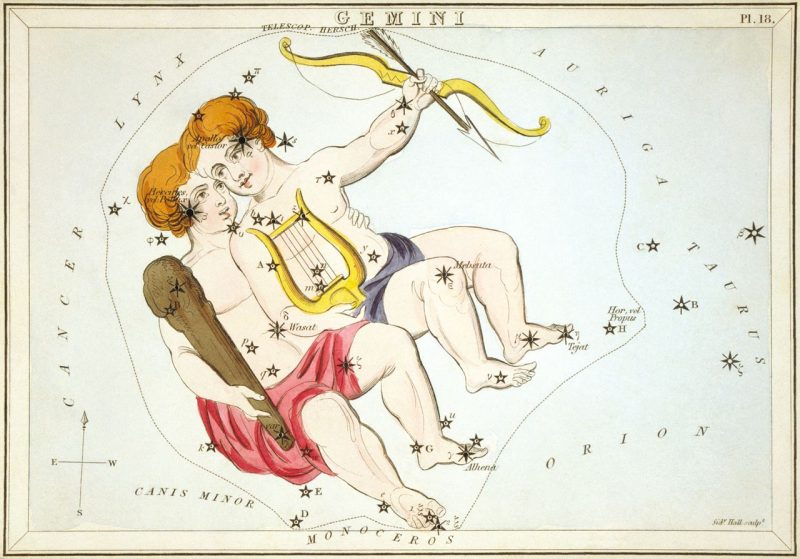
However, there is much mythology associated with these two stars, typically in conjunction with each other. Generally in mythology they are twins. In Greek mythology, Pollux is immortal, the son of Zeus, and Castor is mortal, the son of King Tyndareus of Sparta.
So, they were really half-brothers rather than true twins, with a common mother in Queen Leda. Their conception and birth was a complicated and unlikely affair, though, with their mother succumbing to both Zeus (disguised as a swan) and King Tyndareus on the same night. The resulting birth gave us not only Castor and Pollux but also their sister, Helen of Troy.
According to legend, Castor and Pollux sailed among the Argonauts with Jason in search of the Golden Fleece. By most accounts, Castor was killed in battle and Pollux could not bear to live without him. Zeus allowed Pollux to spend every other day in Olympus with the gods, and the rest of the time in the underworld with his brother.
To honor the brothers’ devotion, Zeus placed their constellation in the sky as a remembrance.
Other stories surrounding the stars
While in many cultures they were the Twins, in India they were the Horsemen, and in Phoenicia they were the two gazelles or two kid-goats. Likewise, early Christians sometimes called them David and Jonathan, while the early Arabian stargazers knew them as two peacocks.
Perhaps the most unexpected interpretation for the Twins (along with the rest of Gemini) was as a “pile of bricks” as reported by Richard Hinckley Allen. Apparently the pile of bricks stood for the foundation of Rome, and in that context Castor and Pollux were associated with Romulus and Remus, the city’s legendary twin founders.
Additionally, the twin stars represent Yin and Yang, the contrasts and complements of life, in Chinese culture. In all of these cases, they represent two of something.
Indeed, you’ll see why if you find these two stars in the night sky.
Castor’s position is RA: 07h 34m 36s, Dec: +31° 53′ 19″
Bottom line: The star Castor, which appears as one of two bright stars in the constellation Gemini the Twins, is actually a six-star system.
Like what you read?
Subscribe and receive daily news delivered to your inbox.
More from
Editors of EarthSky


Celebrate World Oceans Day today, June 8, 2026

June birthstone: Pearl, moonstone or alexandrite


