




Alphecca has several names
As you know, stars often have many names. The brightest star in Corona Borealis is called Alphecca, or Gemma, or Alpha Coronae Borealis or Alpha Cor Bor. The proper name for Alphecca – Gemma – means gem or jewel. So on a dark June night under a dark sky, this star lives up to its name, sparkling within a noticeable semicircle of stars, the constellation Corona Borealis the Northern Crown. In skylore, this C-shaped constellation represents the crown or wreath worn by Ariadne, an ancient Minoan princess.
Alphecca is brighter than the other stars in Corona Borealis, but it’s only moderately bright among the sky’s brightest stars. It shines between summertime’s two most brilliant stars: Arcturus and Vega. An imaginary line drawn between these two stars locates Alphecca every time, about 1/3 of the way from Arcturus to Vega.
When is Alphecca visible?
As seen from mid-northern latitudes, Alphecca shines all night long – or nearly all night long – in April, May and June. Alphecca and this glittery bowl of stars crown the sky on July evenings, and continue to grace the heavens well into November. Then starting around mid-November, Alphecca appears rather low in the west-northwest sky after dusk. It sets shortly after nightfall, then reappears in the east-northeast before dawn.
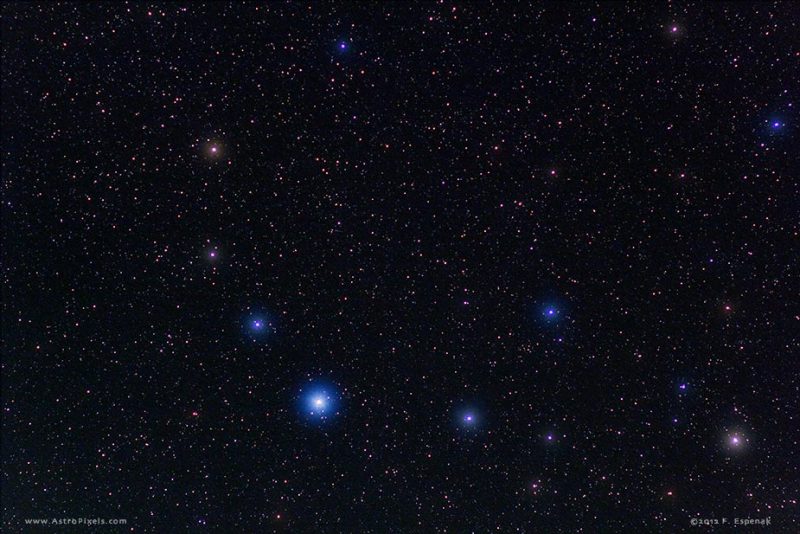

Corona Borealis in skylore
In the ancient Greek myth, the C-shaped pattern of Corona Borealis represented a crown given by Dionysus to Princess Ariadne, daughter of Minos of Crete. Ariadne later married Dionysus, the Greek god of fertility and wine, and she’s said to have worn the crown to her wedding. Later, Dionysus placed her crown in the heavens to commemorate the wedding.
Alphecca in science
The star Alphecca is quite interesting. Like the star Algol in the constellation Perseus, it is an eclipsing binary star, with an orbital period of about 17.4 days. In other words, the fainter of Alphecca’s two component stars passes in front of the brighter one, causing a slight dip in brightness. Contrast that 17.4 days orbit to Earth’s orbit around our local star, the sun, which takes one year. As one star passes in front of the other in the Alphecca system, the star’s variation in brightness is barely perceptible. Meanwhile, the other variable star we mentioned – Algol – has a winking presence easy to observe with the unaided eye.
By the way, the famous Pleiades star cluster sits almost opposite Alphecca (and Corona Borealis) on the sky’s dome. Also starting in mid-November, the Pleiades cluster appears in the east-northeast after dusk, crosses the sky during the night, then gleams over the west-northwest sky before dawn. Thus the Pleiades and Corona Borealis trade places in the sky after about 12 hours. In later November, look for these two star formations at about 6 p.m. local clock time, then note that they have switched positions around 6 a.m. local clock time.
Enjoying EarthSky? Sign up for our free daily newsletter today!
Bottom line: Alphecca is the brightest star in the constellation Corona Borealis the Northern Crown. Also, This star is known as Gemma, which means the jewel of the crown.
Read more about Algol is the demon star
Read more: A ‘new star’ from a nova outburst is expected soon
Like what you read?
Subscribe and receive daily news delivered to your inbox.
More from
Bruce McClure


Can a single season have only 2 full moons?

Virgo the Maiden represents a harvest goddess


