




Alphard (Alpha Hydrae) is the brightest star in the largest constellation in the sky, Hydra the Water Snake. Despite its long length, Hydra’s stars are mostly dim except for Alphard. You will need a very dark sky to see them. Meanwhile, Alphard shines at 2nd magnitude. So it’s about as bright as the stars of the Big Dipper.
Known as the Heart of the Snake, Alphard is a precursor of spring for us in the Northern Hemisphere.
Alphard brings a new season
Alphard’s warm orange color and location in the constellation’s core makes it a good representative for the Snake’s Heart. There is something about Alphard – some combination of its orange color and not-too-showy brightness – that looks friendly.
Like so many skywatchers before you, you’ll love seeing Alphard ascend in the early evening in late February and March as it ushers in a new season. Alphard is located in the upper part of the Water Snake. It has risen when darkness falls by the time of the March equinox.
The constellation is so long that the entire snake doesn’t rise until after midnight in March. Alphard heralds the rest of the snake, which ascends in the sky like a cobra from a snake charmer’s basket. On March, April and May evenings, this great star pattern stretches across a huge portion of the sky, from southeast to southwest above the Milky Way.
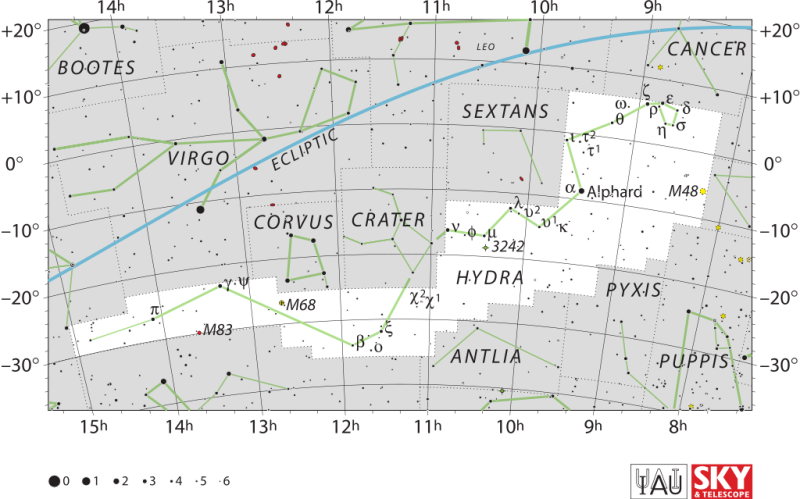
How to find Hydra and Alphard
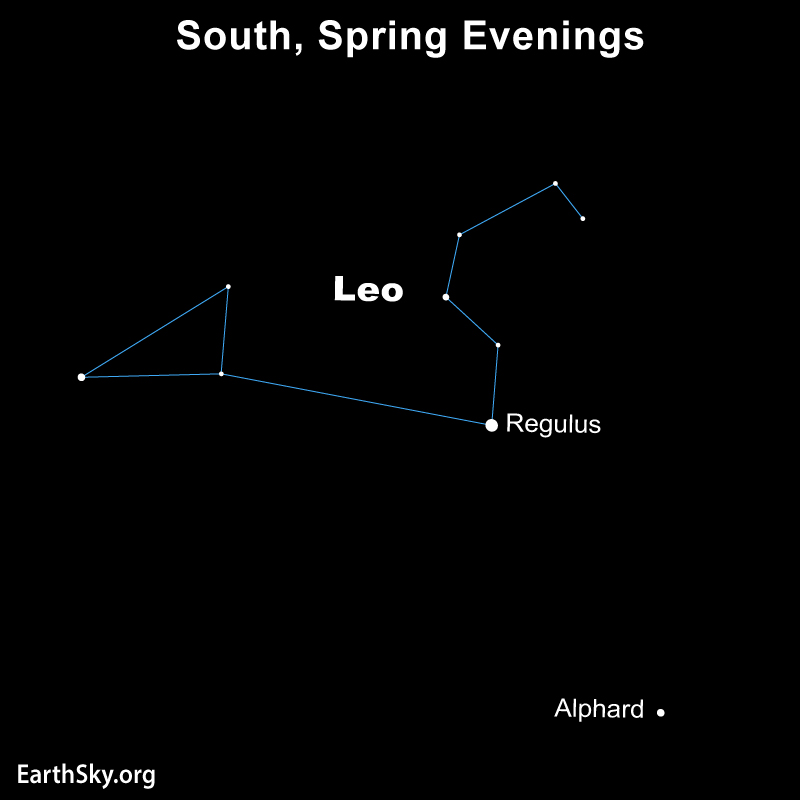
Do you know the constellation Leo the Lion and its famous asterism – the Sickle – shaped like a backward question mark? If so – on an evening in March, April, or May – look for the distinctive backward question mark shape of its head and the triangle body.
You’ll find Alphard not far from Regulus, Leo’s brightest star. Alphard is not as bright as Regulus, but it’s a distinctive orange color. Both Alphard and Regulus are known as the “heart” of their respective animal constellations.
So from Northern Hemisphere locations, look southward to Leo’s lower right to find Alphard. From the Southern Hemisphere, Regulus will be following Alphard across the night sky.
The solitary one
Much like Fomalhaut six months from now, Alphard is said to be a lonely star. It beams as the sole bright light in a sea of dim stars in its part of the sky. The Arabic name Alphard translates as the Solitary One.
Look at Alphard with binoculars to discern its orange color. Alphard’s color shows that it is entering into the autumn of its years, like the color of the orange stars Pollux and Arcturus, and the ruddy star Aldebaran. Old stars’ colors are reminiscent of the orange color of autumn leaves. Like Pollux, Arcturus and Aldebaran, Alphard will shed its outer layers someday soon (by astronomical standards) and shrink into a dead white dwarf star.
Pollux, Arcturus and Aldebaran appear brighter in our sky than Alphard, but that’s because they are so much closer to us. Alphard is intrinsically brighter than any of these stars. Yet it appears fainter, because it lies some 177 light-years away, while Pollux, Arcturus and Aldebaran reside at 34, 37, and 65 light-years away, respectively.
Bottom line: Alphard is the “heart” and brightest star in the constellation Hydra, and it represents a welcome sign of spring for the Northern Hemisphere.
Like what you read?
Subscribe and receive daily news delivered to your inbox.
More from
Bruce McClure


Can a single season have only 2 full moons?

Virgo the Maiden represents a harvest goddess


