
Albireo is 2 stars
Albireo, also known as Beta Cygni, is the 2nd-brightest star in the constellation Cygnus the Swan. At first glance, it doesn’t particularly stand out. But viewing this star through a small telescope can take your breath away. It resolves into a striking double, with one component a lovely gold star and the other a dimmer blue close by. From our perspective, the two stars appear close in the sky, but astronomers don’t believe they’re gravitationally bound to each other. Regardless, the color contrast between the two is so striking that Albireo is considered the most beautiful double star in the heavens.
How to find Albireo
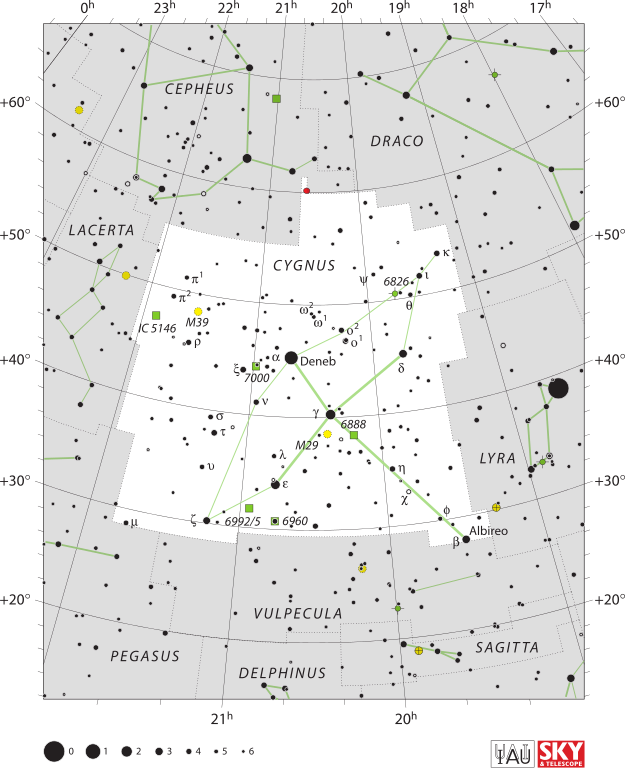
How can you spot Albireo in the night sky? It’s easy to find, if you can locate Cygnus the Swan. Cygnus has an easy-to-recognize shape, that of a cross, and the constellation is also known as the Northern Cross. The brightest star in Cygnus – Deneb – marks the head of the Cross or the Tail of the Swan. Albireo marks the base of the Cross or the Head of Cygnus.
And how can you see Albireo as two stars? They’re best viewed at 30X (“30 power” or a magnification of 30). Unless you have exceedingly powerful binoculars, mounted on a tripod, binoculars won’t show you Albireo as two stars. But any small telescope will. When you do see Albireo as two stars, be sure to notice the striking color contrast between the two.
Science of Albireo
The brighter, golden star – Albireo A – is about 430 light-years away. Albireo B, the dimmer blue star, is around 400 light-years distant.
In 2022, NASA said:
Albireo A and B most likely represent an optical double star and not a physical binary system because the two components have clearly different measured motions through space.
However, Albireo A is a binary star, with two stars so close together that you can’t see them as separate. The Albireo A binary star system has an orbital period of 121.6 years. The brighter star is responsible for the gold color you see through a telescope. It’s a red supergiant star, about 5 times the mass of the sun. It outshines its fainter companion, a hot main sequence star that’s 2.7 times the sun’s mass. However, in a recent analysis of the Albireo A binary system, astronomers were surprised to find that there may be another yet-undetected star in the mix, possibly making Albireo A a triple star system.
Albireo B, the fainter blue star of the pair when viewed through a small telescope, appears just 34 arc seconds away from gold-colored Albireo A. It’s a hot blue star, about 3.7 times the sun’s mass.
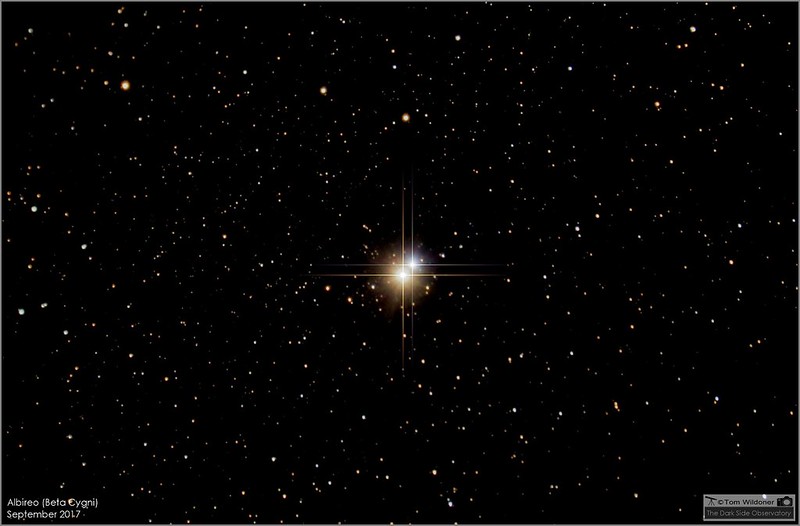
Bottom line: Through a telescope, Albireo, a seemingly nondescript star in the constellation Cygnus, pops as a stunning gold and blue double star. Astronomers still don’t know if Albireo A is a triple star.
Like what you read?
Subscribe and receive daily news delivered to your inbox.
More from
Bruce McClure


Cor Caroli, named for the heart of a king

1st eclipse season of 2024 starts March 24-25
On the equinox, are day and night equal?
Equinox fun: Track sun’s shift between now and the solstice