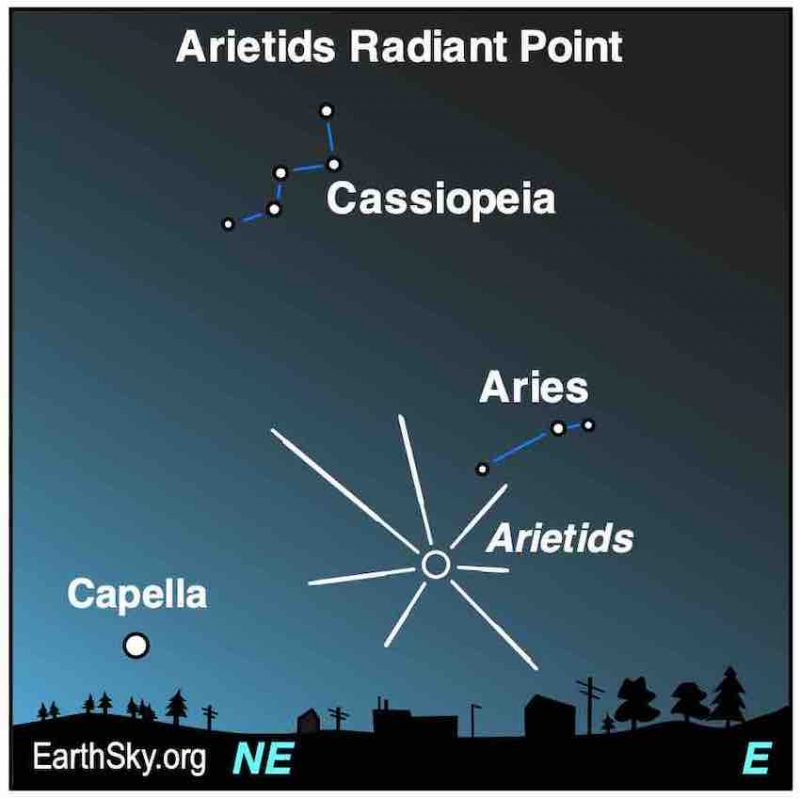
Up next is the daytime Arietid meteor shower, you might catch some before dawn on the mornings around June 10. They’ll compete with a thick waxing crescent moon. Try to watch for meteors in the moon’s shadow.
June 2026 daytime meteor shower … the Arietids
Most meteor showers are easy to observe. Just find a dark sky, and look up! But what about meteor showers that happen in the daytime, when the sun is up? The Arietids are sometimes said to be the most active daytime meteor shower. In 2026, their predicted** peak will be around the mornings of June 10. You might catch some Arietids around that morning in the dark hour before dawn.
When to watch: Watch from May 22 to July 3. There’s a predicted** peak for the mornings around June 10, 2026. Watch for them in the sunrise direction in the dark hour before dawn breaks.
Nearest moon phase: In 2026, a 3rd quarter moon occurs at 10:00 UTC on June 8. So on the mornings around June 10, a thick waxing crescent moon will interfere with watching for meteors. Watch from a place that’s in the moon shadow or find a distant object to block out the light of the moon.
Radiant: The shower’s radiant point – the point in the sky from which the meteors appear to radiate – is in the constellation Aries. You’ll find this constellation in the east before sunrise.
Duration of shower: May 22 to July 3.
Expected meteors at peak: This is tricky for daytime meteor showers because once the sun comes up, you won’t be able to see them. But the Arietids have a strong zenithal hourly rate (ZHR)! Meteor counts with radar and radio echoes have indicated a rate of 60 meteors per hour, and perhaps as high as 200 meteors per hour.
Note: The Arietids are sometimes said to be the most active daytime meteor shower.
Read more: Arietids, most active daytime meteor shower
Late July to mid-August 2026 meteors … the Delta Aquariids
Predicted peak: The peak is predicted** for 10 UTC on July 30, 2026. But this shower doesn’t have a noticeable peak. It rambles along steadily from late July through early August, joining forces with the August Perseids.
When to watch: Watch late July through early August, mid-evening to dawn.
Duration of shower: July 18 to August 21.
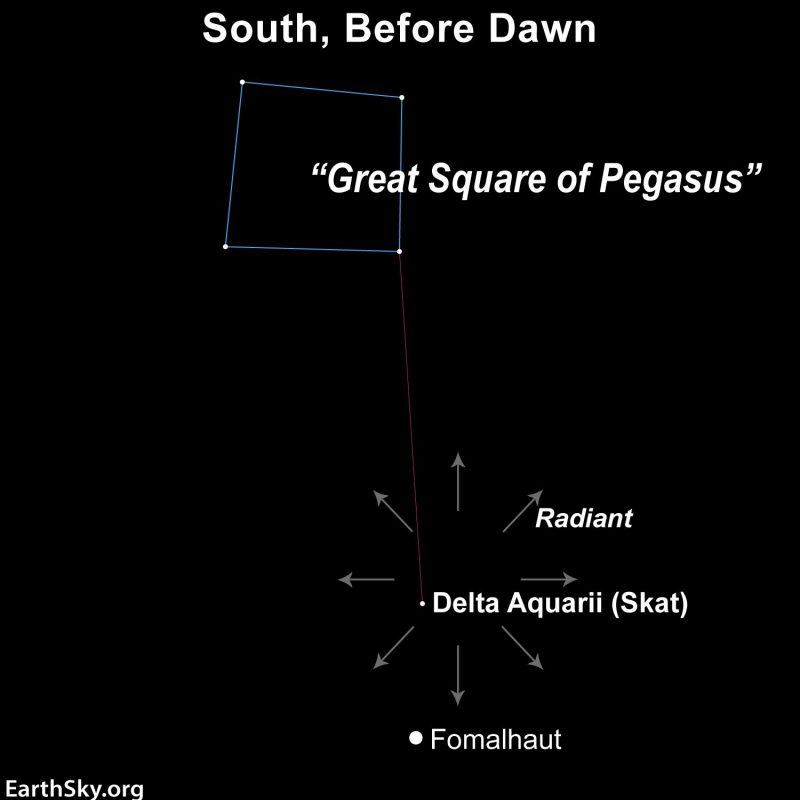
Radiant: Rises in mid-evening, highest around 2 a.m. and low in the sky by dawn. See chart below.
Nearest moon phase: In 2026, the full moon falls at 14:36 UTC on July 29. Take advantage of the moon-free mornings – after midnight – the week before for watching the Delta Aquariids (and the early Perseids).
Expected meteors at peak, under ideal conditions: The Delta Aquariids’ maximum hourly rate can reach 15 to 20 meteors in a dark sky with no moon. You’ll typically see plenty of Delta Aquariids mixed in with the Perseids, if you’re watching in early August.
Note: Like May’s Eta Aquariids, July’s Delta Aquariids favors the Southern Hemisphere. Skywatchers at high northern latitudes tend to discount it. But the shower can be excellent from latitudes like those in the southern U.S. Delta Aquariid meteors tend to be fainter than Perseid meteors. So a moon-free dark sky is essential. About 5% to 10% of the Delta Aquariid meteors leave persistent trains, glowing ionized gas trails that last a second or two after the meteor has passed.
Read more: All you need to know about Delta Aquariid meteors
Mid-July to mid-August 2026 meteors … the Perseids
Predicted peak: The peak is predicted** for 14:53 UTC on August 13, 2026. So the mornings of August 12 and 13 are probably your best bets. August 14 might be good as well, but be aware that the Perseids tend to fall off rapidly after their peak.
When to watch: The moon will be a new moon during 2026’s peak of the Perseid meteor shower. So you’ll have dark skies for meteor viewing. This shower rises to a peak gradually, then falls off rapidly. And Perseid meteors tend to strengthen in number as late night deepens into the wee hours before dawn. The shower is often best just before dawn.
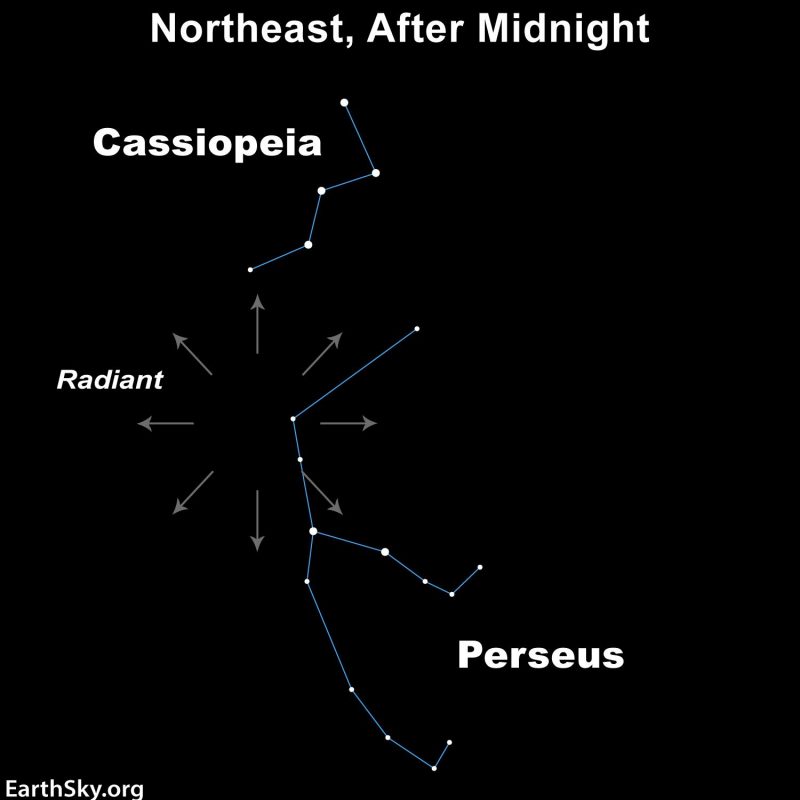
Radiant: The radiant rises in the middle of the night and is highest at dawn. See chart below.
Nearest moon phase: The new moon falls at 17:37 UTC on August 12. In fact, those lucky enough to be observing the August 12 total solar eclipse, might see some Perseids during totality.
Duration of shower: July 14 to September 1. This time period is when we’re passing through the meteor stream in space!
Expected meteors at peak, under ideal conditions: Under a dark sky with no moon, skywatchers frequently report 90 meteors per hour, or more. In 2026, you’ll have a moonless sky to watch for Perseids. The August Perseid meteor shower is rich and steady, from early August through the peak. The meteors are colorful. And they frequently leave persistent trains. All of these factors make the Perseid shower perhaps the most beloved meteor shower for the Northern Hemisphere.
Read more: All you need to know about Perseid meteors
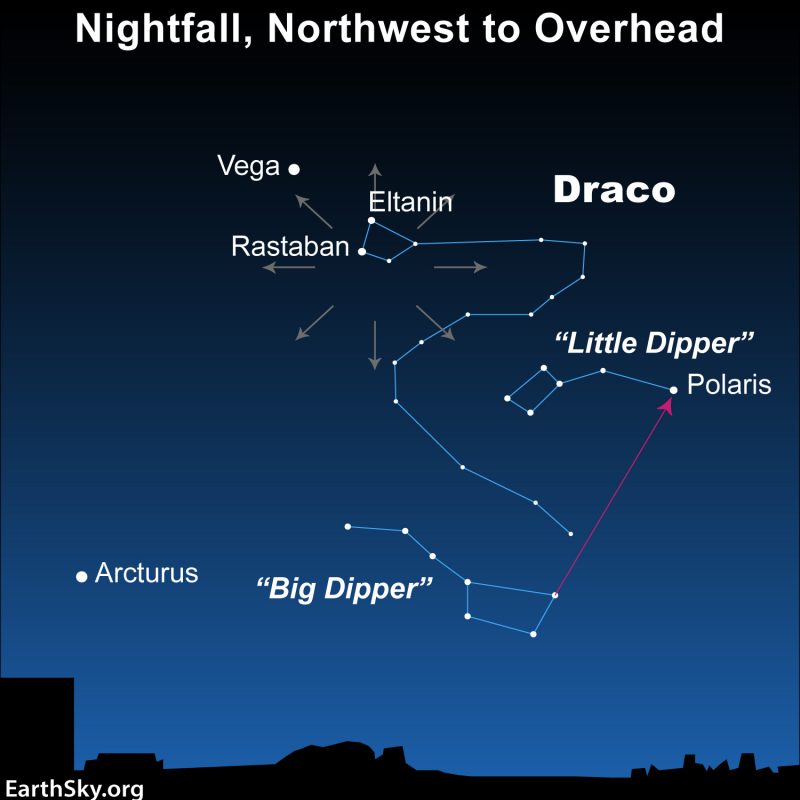
Early October meteors … the Draconids
Predicted peak: The peak is predicted** for 1 UTC on October 9, 2026.
When to watch: The best time to watch the Draconids in 2026 is as darkness falls on the evening of October 8 through the wee hours of the morning on October 9.
Overall duration of shower: October 6 through 10.
Radiant: Highest in the sky in the evening hours. See chart below.
Nearest moon phase: new moon is 15:50 UTC on October 10. So a waning crescent moon in the morning sky shouldn’t interfere with watching for Draconid meteors this year.
Expected meteors at peak, under ideal conditions: Under a dark sky with no moon, you might catch 10 Draconid meteors per hour.
Note: The Draconid shower is a real oddity, in that the radiant point stands highest in the sky as darkness falls. That means that, unlike many meteor showers, more Draconids are likely to fly in the evening hours than in the morning hours after midnight. This shower is usually a sleeper, producing only a handful of languid meteors per hour in most years. But watch out if the Dragon awakes! In rare instances, fiery Draco has been known to spew forth many hundreds of meteors in a single hour. That possibility keeps many skywatchers outside during this shower. Since the parent comet of this shower – Comet 21P/Giacobini-Zinner – was at perihelion in March of 2025, does that mean we’ll see a storm of Draconid meteors this year? Maybe.
Read more: All you need to know about Draconid meteors
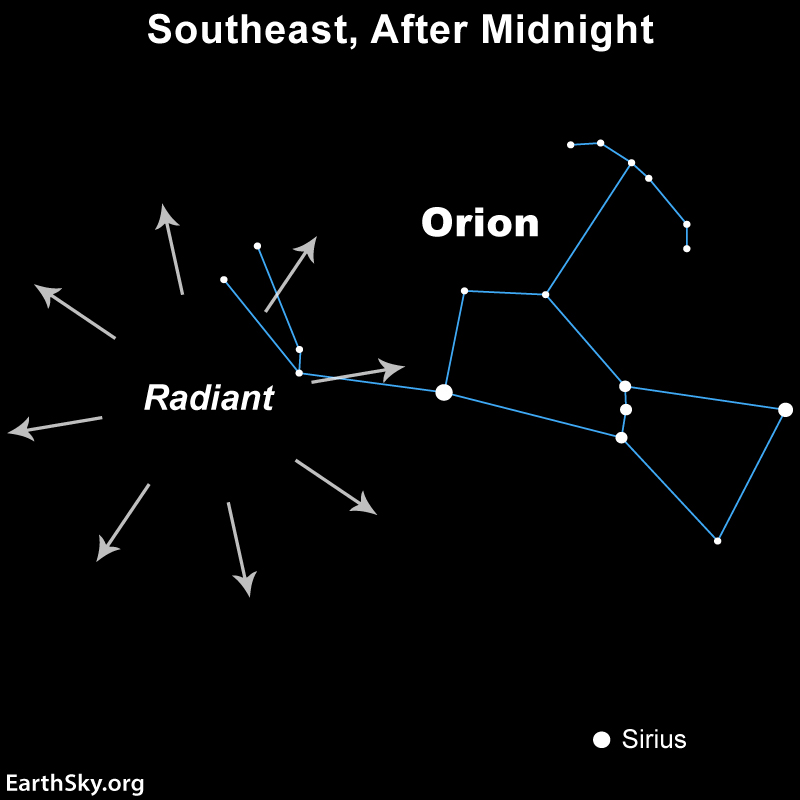
Late October meteors … the Orionids
Predicted peak: The peak is predicted** for 6:54 UTC on October 23, 2026.
When to watch: Watch for Orionid meteors on the morning of October 23, starting after midnight through the wee hours before dawn.
Overall duration of shower: September 26 to November 22. This time period is when we’re passing through the meteor stream in space!
Radiant: The radiant rises before midnight and is highest in the sky around 2 a.m. See chart below.
Nearest moon phase: The full moon falls at 4:12 UTC on October 26. So, during the Orionids’ peak, there’ll be a bright waxing gibbous moon visible after midnight. However, the moon will set several hours before dawn. So the best time to watch is during the dark hours before dawn.
Expected meteors at peak, under ideal conditions: Under a dark sky with no moon, the Orionids exhibit a maximum of about 10 to 20 meteors per hour. Expect reduced rates this year because of moonlight.
Note: These fast-moving meteors occasionally leave persistent trains. The Orionids sometimes produce bright fireballs.
Read more: Everything you need to know Orionid meteors
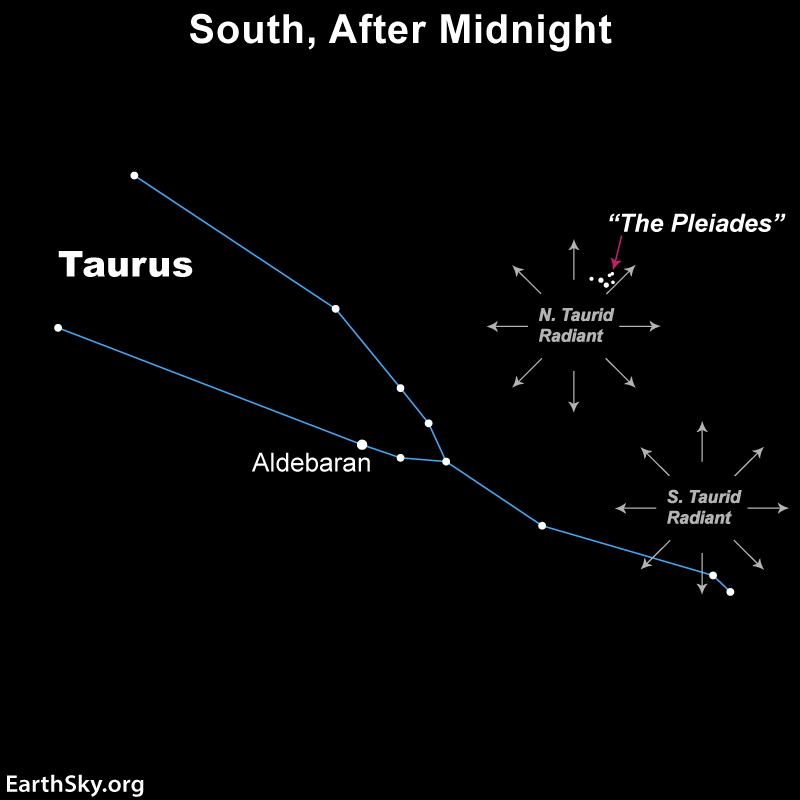
October into early November … the South and North Taurids
Predicted peak: The South Taurids’ predicted** peak is for 0:22 UTC on November 5, 2026. The North Taurids’ predicted** peak is for 6:59 UTC on November 9, 2026. Both the South and North Taurids don’t have very definite peaks. They ramble along in October and November and are especially noticeable from late October into early November, when they overlap.
When to watch: Best around midnight when the radiant is highest in the sky.
Overall duration of shower: The South Taurids run from about September 23 to November 12. North Taurids are active from about October 13 to December 2. This time period is when we’re passing through the Southern Taurid meteor stream in space! And time period is when we’re passing through the Northern Taurid meteor stream in space!
Radiant: Rises in early evening, highest in the sky around midnight. See chart below.
Nearest moon phases: In 2026, the new moon falls at 7:02 UTC on November 9. So moonlight will not interfere with Taurid meteors in 2026. You’ll catch Taurid meteors throughout October and November. Visit Sunrise Sunset Calendars to see moon rising times for your location. Be sure to check the moon rising time box.
Expected meteors at peak, under ideal conditions: Under dark skies with no moon, both the South and North Taurid meteor showers produce about five meteors per hour (10 total when they overlap). Also, watch for fireballs. In most years, only one percent of all Taurid meteors are fireballs. In exceptional years, when the Earth passes through a concentrated field of debris, the percentage can be as high as seven percent.
Note: Taurid meteors tend to be slow-moving but sometimes very bright. The showers sometimes produce fireballs, which made their cyclical reappearance in 2008, 2015 and 2022. The next predicted swarm or outburst of Taurid fireballs is in 2032.
Read more: All you need to know about the Taurid meteors
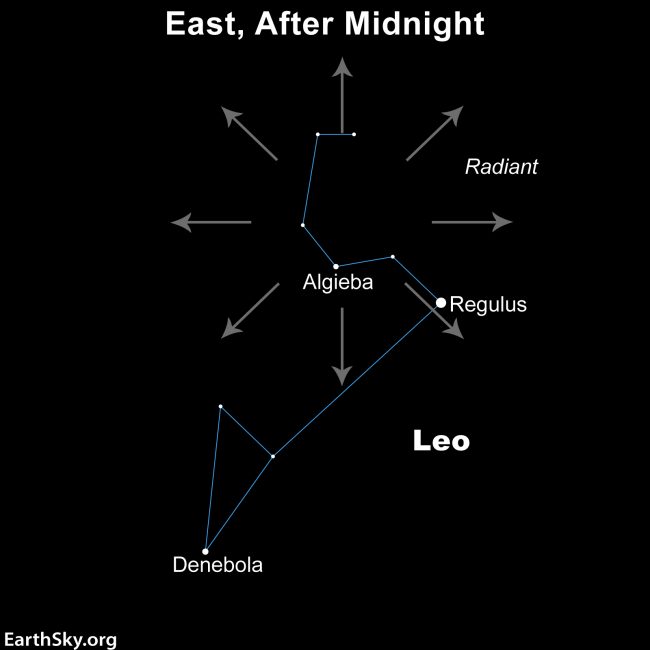
Mid-November meteors … the Leonids
Predicted peak: The peak is predicted** for 0 UTC on November 18, 2026.
When to watch: Watch late on the night of November 17 until dawn on November 18. The morning of November 17 might be worthwhile, too.
Duration of shower: November 3 through December 2. This time period is when we’re passing through the meteor stream in space!
Radiant: Rises around midnight, highest in the sky at dawn.
Nearest moon phase: In 2026, the 1st quarter moon falls at 11:48 UTC on November 17. So the quarter moon might interfere with and of the fainter meteors in 2026.
Expected meteors at peak, under ideal conditions: Under a dark sky with no moon, you might see 10 to 15 Leonid meteors per hour. In 2026, expect to see reduced numbers because of the 1st quarter moon.
Note: The famous Leonid meteor shower produced one of the greatest meteor storms in living memory. Rates were as high as thousands of meteors per minute during a 15-minute span on the morning of November 17, 1966. That night, Leonid meteors did, briefly, fall like rain. Some who witnessed it had a strong impression of Earth moving through space, fording the meteor stream. Leonid meteor storms sometimes recur in cycles of 33 to 34 years. But the Leonids around the turn of the century – while wonderful for many observers – did not match the shower of 1966. And, in most years, the Lion whimpers rather than roars.
Read more: All you need to know about Leonid meteors
Early to mid-December meteors … the Geminids
Predicted peak: is predicted** for 5:44 UTC on December 14, 2026.
When to watch: Since the radiant rises in mid-evening, you can watch for Geminids all night on December 13-14. The days before and after might be good as well. A waxing crescent moon will not interfere with meteor watching.
Overall duration of shower: November 19 to December 24. This time period is when we’re passing through the meteor stream in space!
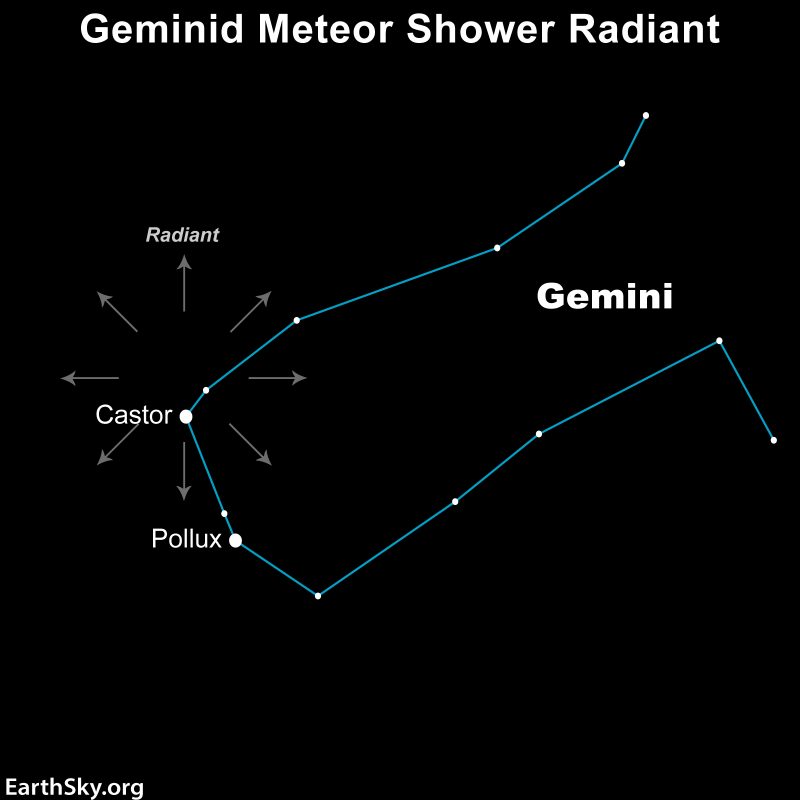
Radiant: Rises in mid-evening, highest around 2 a.m. See chart below.
Nearest moon phase: In 2026, the first quarter moon falls several days after the predicted peak at 5:43 UTC on December 17. So you’ll have dark skies to watch for meteors.
Expected meteors at peak, under ideal conditions: Under a dark sky with no moon, you might catch 120 Geminid meteors per hour.
Note: The bold, bright – and sometimes colorful – Geminids give us one of the Northern Hemisphere’s best showers, especially in years when there’s no moon. They’re also visible, at lower rates, from the Southern Hemisphere. The meteors are plentiful, rivaling the August Perseids.
Read more: All you need to know about Geminid meteors
Meteor shower around the December solstice … the Ursids
Predicted peak: is predicted** for 20:59 UTC on December 22, 2026.
When to watch: Watch for Ursids on the evening of December 21st through dawn. You’ll have a moonlit sky for watching meteors.
Duration of shower: Ursids range from December 13 to 24, so you might see some intermingling with the Geminids’ peak. This time period is when we’re passing through the meteor stream in space!
Radiant: Circumpolar at northerly latitudes. Due to the northern location of the radiant point in the sky, these meteors are not well seen from southern latitudes and the Southern Hemisphere.
Nearest moon phase: A full moon occurs at 1:28 UTC on December 24. So the bright gibbous moon will probably hinder seeing all but the brightest Ursids in 2026.
Note: This low-key meteor shower – which always peaks around the solstice – is somewhat overlooked due to the holiday season. Its hourly rate – about 5 to 10 meteors per hour – is lower than that of the Geminid shower, which peaked over a week before. However, it’s had an occasional outburst of 100 meteors per hour. So the Ursids are worth a look! In 2026, you’ll have Ursid meteors in moonlight.
Read more: Ursid meteors peak around December solstice

Early January 2027 meteors … the Quadrantids
When to watch: The best time to watch for the 2027 Quadrantids is the hours before dawn on January 4. (The predicted peak** is 05:47 UTC on January 4).
Nearest moon phase: A new moon will come at 20:24 UTC on January 7, 2027, so the waning crescent moon shouldn’t interfere with Quadrantid meteors.
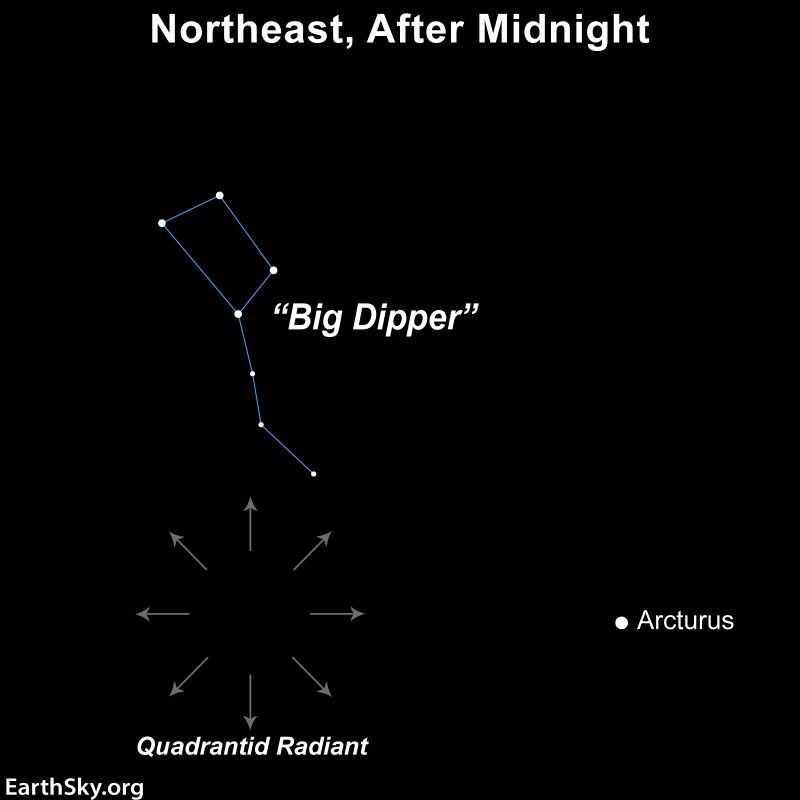
Radiant: Rises in the north-northeast after midnight and is highest before dawn. The radiant point for the Quadrantids is in a now-obsolete constellation, Quadrans Muralis the Mural Quadrant. Nowadays, we see the radiant near the famous Big Dipper asterism. Because the Quadrantid radiant is far to the north on the sky’s dome, this is mostly a far-northern shower, not as good for the Southern Hemisphere.
Expected meteors at peak, under ideal conditions: Under a dark sky with no moon, when the radiant is high in the sky, the Quadrantids can (briefly) produce over 100 meteors per hour. In 2027, you’ll have dark skies and the Quadrantids often produce really bright meteors known as fireballs.
Duration of shower: The Quadrantid meteor shower runs from mid-November through mid-January each year, according to this 2017 article in the journal Icarus. You might see a Quadrantid streak by any time during that interval. But most activity is centered on the peak. This time period is when we’re passing through the meteor stream in space!
Note: The Quadrantid shower is one of four major meteor showers each year with a sharp peak (the other three are the Lyrids, Leonids, and Ursids).
Read more: All you need to know about Quadrantid meteors
April 2027 meteors … the Lyrids
When to watch in 2027: After midnight and through dawn on the mornings of April 22 and 23. The predicted** peak is 01:11 UTC on April 23. The peak of the Lyrids is narrow (no weeks-long stretches of meteor-watching, as with some showers). In 2027, the full moon falls at 22:27 UTC on April 20. So meteor watching after midnight and before dawn on those mornings will compete with a bright waning gibbous moon.
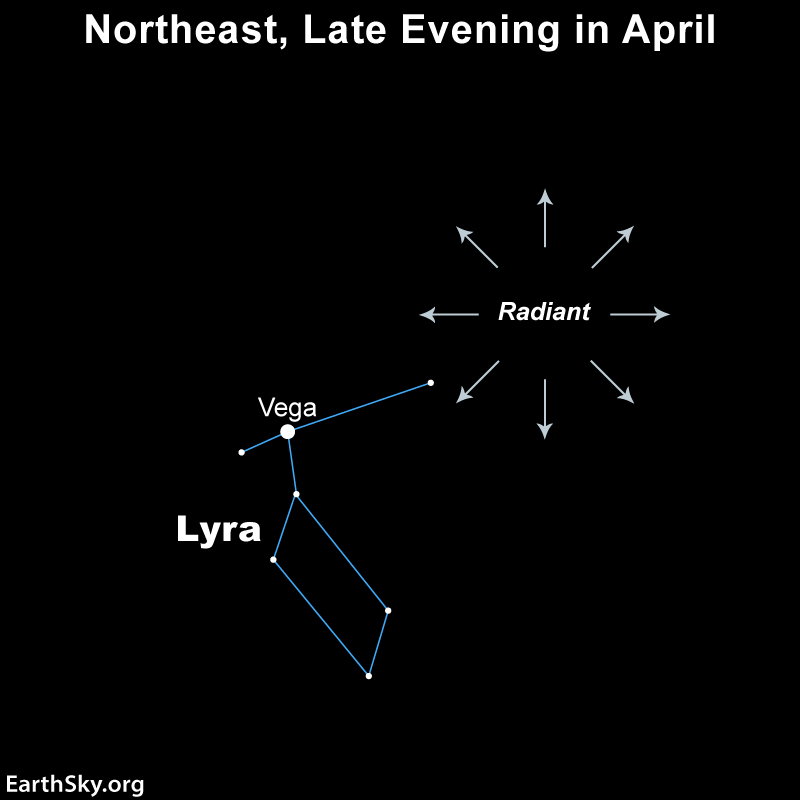
Radiant: Rises before midnight, highest in the sky at dawn.
Nearest moon phase: Full moon falls at 22:27 UTC on April 20. So a fat waning gibbous moon – that sets after dawn – will wash out all but the brightest meteors. The best time to watch is after midnight and before dawn on the mornings of April 22 and 23. And be sure to place yourself in the moon’s shadow to help block out the bright moonlight.
Duration of shower: April 15 to April 29. This time period is when we’re passing through the meteor stream in space!
Expected meteors at peak, under ideal conditions: In a dark sky with no moon, you might see 10 to 15 Lyrids per hour. In 2027, due to moonlight, those numbers will be reduced. The Lyrids are known for uncommon surges that can sometimes bring rates of up to 100 per hour! Read more about Lyrid outbursts. Lyrids are known for their bright and colorful meteors, sometimes even producing fireballs. Fireballs are exceptionally bright meteors that outshine the planet Venus.
Note for Southern Hemisphere: This shower’s radiant point is far to the north on the sky’s dome. So the Southern Hemisphere will see fewer Lyrid meteors. Still, you might see some!
Meteor train possibilities? In a moonless sky, a few Lyrid meteors can leave persistent trains. That is, they leave a trail of ionized gases that glow for a few seconds after the meteor has passed. Lyrids are known to produce fireballs.
Read more: All you need to know about Lyrid meteors
May 2027 meteors … the Eta Aquariids
When to watch: The best morning to watch is May 5, 2027, in the hours before dawn. The American Meteor Society is listing 9:28 UTC on May 5 as the shower’s predicted** peak time. The fact is that the peak of this shower stretches out over several days. So you can expect elevated numbers of meteors a few days before and after the peak time. The mornings of both May 4 and May 6 are also good times to watch!
Nearest moon phase: The new moon will fall at 10:58 UTC on May 6. So there will be dark skies to watch for the 2027 Eta Aquariids.
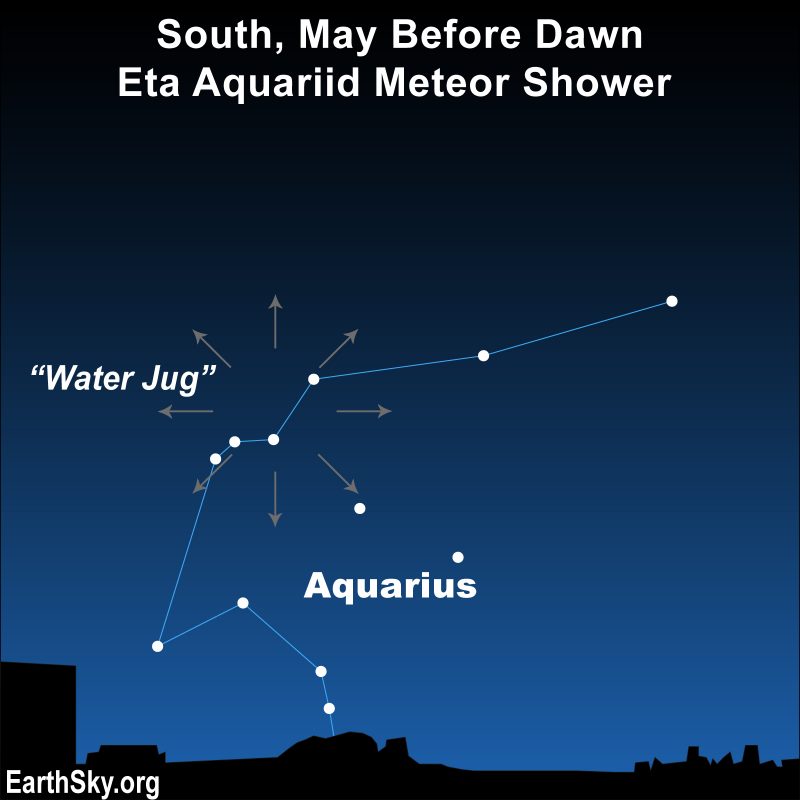
The radiant: will rise in the wee hours, climbing toward its highest point at dawn. That’s why the hours before dawn will be the best time to watch this shower.
Duration of shower: April 15 to May 27. This time period is when we’re passing through the Eta Aquariid meteor stream in space!
Expected meteors at peak, under ideal conditions: The zenithal hourly rate (ZHR) of this shower (the rate at the shower’s peak, under a dark sky, with no moon, when the radiant is high in the sky) is 60. And be aware that the shower is best for latitudes like those in the southern half of the U.S. or even farther south, in the Southern Hemisphere. These are swift meteors that produce a high percentage of persistent trains.
Note: The Eta Aquariids’ radiant will be on the ecliptic, which will ride low in the sky on spring mornings as seen from far northerly latitudes. This shower favors more southerly latitudes (like those in the southern U.S. or the Southern Hemisphere), where the radiant appears higher in the morning sky. It’s often the Southern Hemisphere’s best meteor shower of the year.
Read more: All you need to know about Eta Aquariid meteors
Meteor shower-watching resources
Learn how to shoot photos of meteors
How high up are meteors when they begin to glow?
Find a Dark Sky Place, from the International Dark Sky Association
Heavens-Above: Satellite predictions customized to your location
Stellarium Online: Star maps customized to your location
Dark Site Finder, from astrophotographer Kevin Palmer
EarthSky’s tips for meteor-watchers
Why do meteor showers have a radiant point?
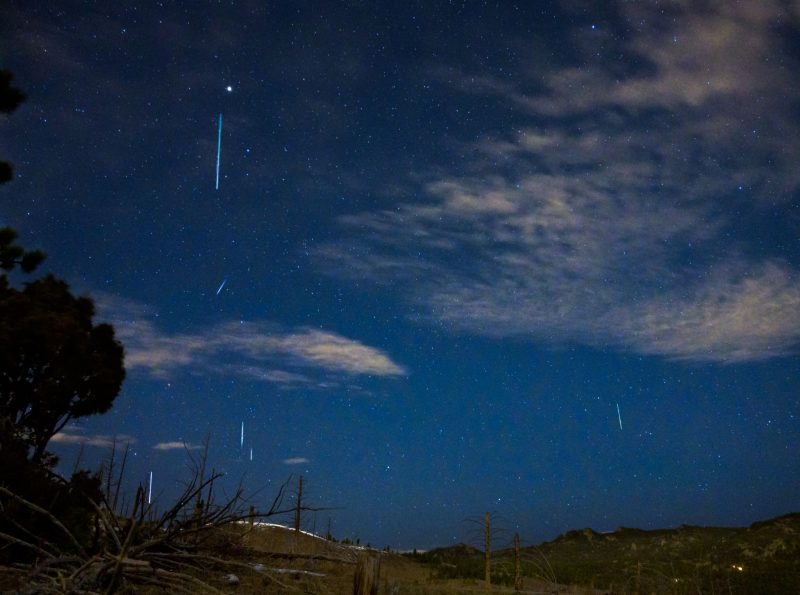
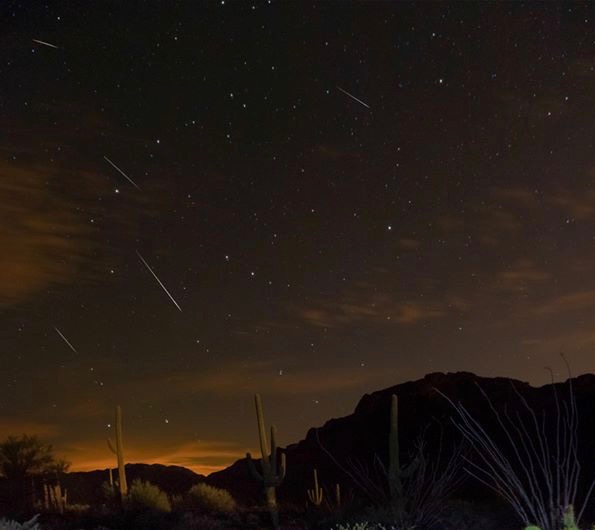
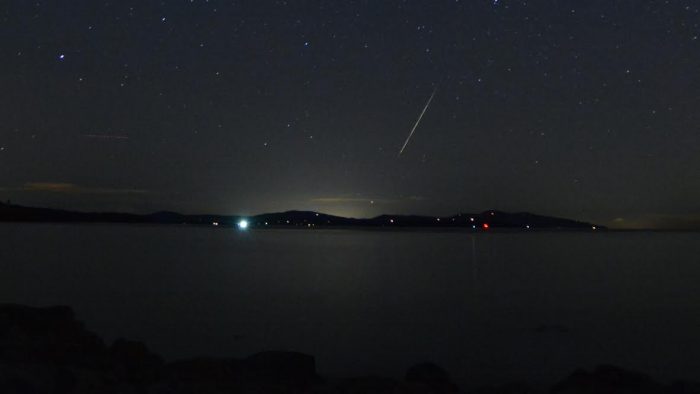
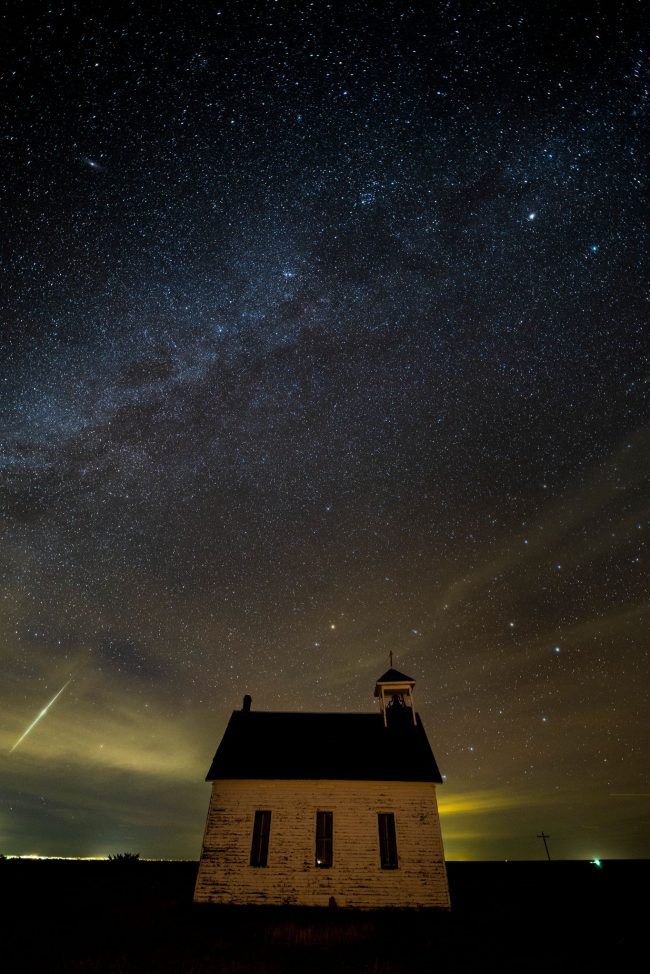
Meteor shower guide: photos from the EarthSky community
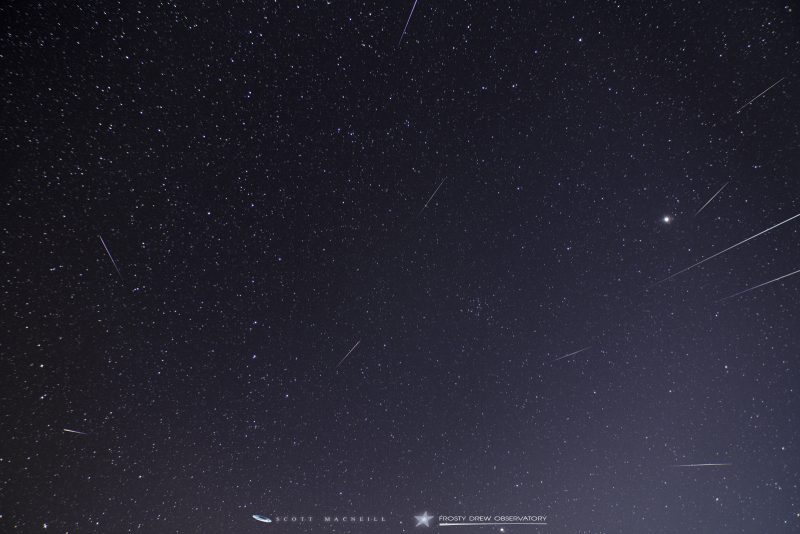
Meteor shower words of wisdom
A wise person once said that meteor showers are like fishing. You go, you enjoy nature … and sometimes you catch something.
Bottom line: Up next is the daytime Arietid meteor shower, you might catch some before dawn on the mornings around June 10. They’ll compete with a thick waxing crescent moon. Try to watch for meteors in the moon’s shadow.
**Peak times for meteor showers provided by Robert Lunsford of the American Meteor Society. Note that predictions for meteor shower peak times may vary. Back to top.
Like what you read?
Subscribe and receive daily news delivered to your inbox.
More from
Editors of EarthSky


Celebrate World Oceans Day today, June 8, 2026

June birthstone: Pearl, moonstone or alexandrite