Time zones
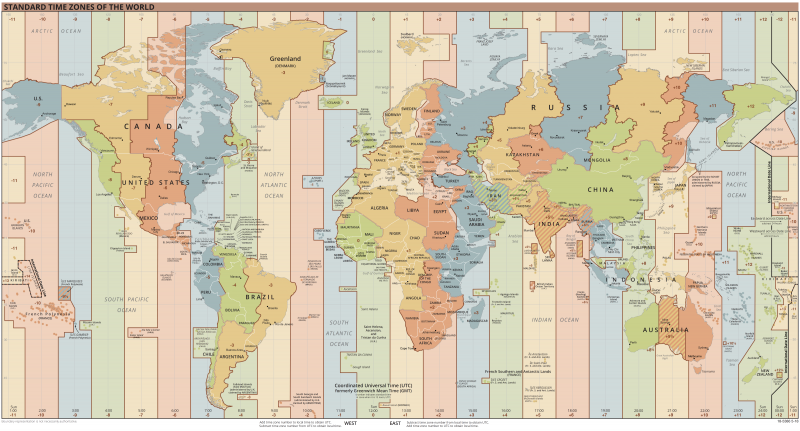
The world is divided up into about 24 time zones. We say about because some states, regions and countries shift their times by 1/2 hour from the strict 24-hour divisions. Standard time within most time zones is a certain whole number of hours offset from Coordinated Universal Time (UTC), maintained by a large number of very precise atomic clocks kept at laboratories around the world, including the U.S. Naval Observatory. UTC is the successor to Greenwich Mean Time (GMT), although their exact definitions differ. By the way, the worldwide community of scientists no longer use GMT.
Looking for a time zone converter? Here’s a handy one at WorldTimeBuddy.com, and another at Online Alarm Kur.
Translate UTC into your local time
United States
Atlantic Daylight Time| subtract 3 hours from UTC
Atlantic Standard Time| subtract 4 hours from UTC
Eastern Daylight Time| subtract 4 hours from UTC
Eastern Standard Time| subtract 5 hours from UTC
Central Daylight Time| subtract 5 hours from UTC
Central Standard Time| subtract 6 hours from UTC
Mountain Daylight Time| subtract 6 hours from UTC
Mountain Standard Time| subtract 7 hours from UTC
Pacific Daylight Time| subtract 7 hours from UTC
Pacific Standard Time| subtract 8 hours from UTC
Alaska Daylight Time| subtract 8 hours from UTC
Alaska Standard Time| subtract 9 hours from UTC
Hawaii-Aleutian Standard Time| subtract 10 hours from UTC
Samoa Standard Time| subtract 11 hours from UTC
Europe/Middle East
Greenwich Mean Time| same as UTC
British Summer Time| add 1 hour to UTC
Central European Time| add 1 hour to UTC
Central European Summer Time| add 2 hours to UTC
Eastern European Time| add 2 hours to UTC
Eastern European Summer Time| add 3 hours to UTC
Charlie Time (middle east)| add 3 hours to UTC
Delta Time (middle east)| add 4 hours to UTC
Australia
Western Standard Time| add 8 hours to UTC (Summer Time is not used in Western Australia)
Central Standard Time| add 9:30 hours to UTC
Central Summer Time| add 10:30 hours to UTC
Eastern Time| add 10 hours to UTC
Eastern Summer Time| add 11 hours to UTC
For Asian, African and South American time zones visit WorldTimeZones.com
Examples of how to convert UTC to your local time
Let’s say you live in Houston, Texas, which is in United States Central Standard Time. To convert 18:00 UTC (6:00 p.m.) into your local time, subtract 6 hours, to get 12 noon CST. During daylight saving (summer) time, you would only subtract 5 hours, so 18:00 UTC would convert to 1:00 p.m CDT. Note that the U.S. uses a 12-hour format with a.m. and p.m.
Other countries use 24-hour time. Let’s say you’re in Paris, France, which is in Central European Time. To convert 18:00 UTC into your local time, add 1 hour, to get 19:00 CET. In summer, add 2 hours to get 20:00 CEST.
When converting a zone time to or from UTC, dates must be properly taken into account. For example, 10 March at 02:00 UTC (2:00 a.m.) is the same as March 9 at 9:00 p.m. EST (U.S.).
About the International Date Line
The table is also useful to determine the difference between the time observed in any two zones. For example, the table shows that Eastern Standard Time is three hours ahead of Pacific Standard Time (U.S.). WorldTimeBuddy.com enables you to select up to four time zones to convert.
Bottom line: The Earth has about 24 time zones, but when scientists mention a time, it’s almost always Coordinated Universal Time (UTC). Here’s how to translate UTC to your local time zone.
Like what you read?
Subscribe and receive daily news delivered to your inbox.
More from
Editors of EarthSky


Celebrate World Oceans Day today, June 8, 2026

June birthstone: Pearl, moonstone or alexandrite